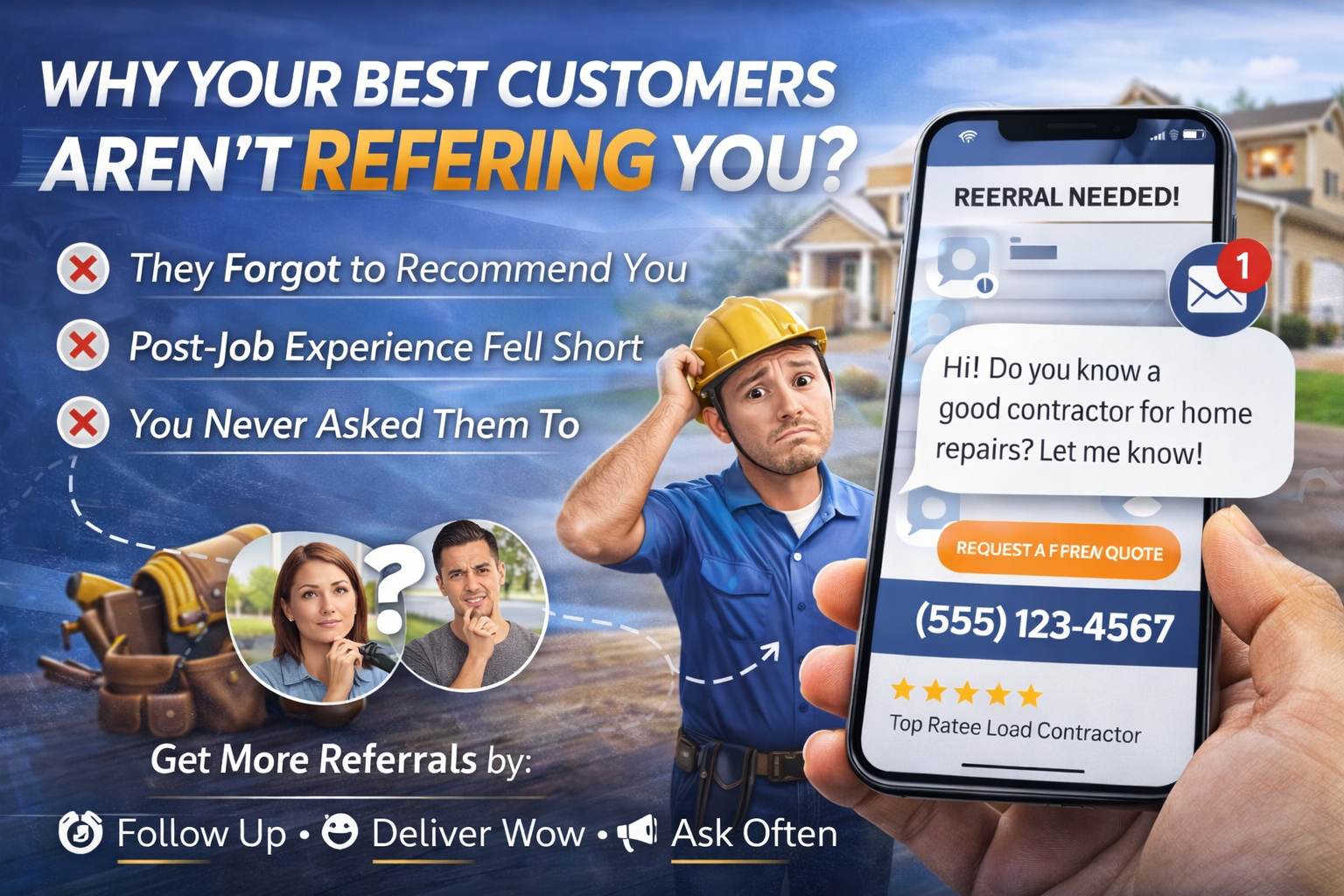
Picture this. You just finished a bathroom remodel. The homeowner is thrilled. They shake your hand, say "this looks incredible," and tell you they're going to "tell everyone about you." You drive away feeling great.
Weeks later, their friend mentions they need a plumber. Your customer thinks of you... so they try to pass along your info. But...
They scroll through their texts trying to find your number. They may look your business card... but they can't find it. So they say the six words that kill your referral:
"I found a guy on Google."
That referral — a warm lead from a trusted friend, the single highest-converting type of lead in existence — just died. Not because your customer didn't want to refer you. Because they couldn't.
This is happening to you right now. After every job you complete. And it's costing you far more than you realize.
The Referral Paradox: Why Happy Customers Stay Silent
Here's something that doesn't get talked about enough in the trades: customer satisfaction and referral rates are barely correlated. Contractors with 5-star reviews and raving fans still get surprisingly few referrals. Meanwhile, some average contractors seem to get referrals constantly.
The difference isn't quality of work. It's ease of referral.
Think about your own behavior as a consumer. When was the last time someone asked you for a restaurant recommendation? You probably had three or four great places in mind. But which one did you actually recommend? The one whose name you could remember right that second. Not necessarily the best meal you ever had — the one that came to mind fastest.
Referrals work the same way for contractors. The tradesperson who gets recommended isn't always the most skilled. It's the one whose info is most accessible at the moment the recommendation is requested.
The real problem
83% of satisfied customers say they're willing to refer a business they had a good experience with. But only 29% actually do. That gap — the 54% of referrals that die between intention and action — is the single biggest growth opportunity in your business.
5 Hidden Reasons Your Referrals Are Dying
Most advice about getting more referrals boils down to "do great work and ask for referrals." That's not wrong, but it misses the actual mechanics of why referrals fail. Here are the five real reasons your happy customers aren't sending you business:
1. Your Contact Info Has a Half-Life
A paper business card has a lifespan of about 7 days before it's lost, recycled, or buried in a drawer. A text message with your number gets buried under dozens of other messages within a week. Even if a customer saves your number, they often save it as "Plumber" or "Mike" — and six months later, they have no idea which "Mike" that is.
Your contact info is a depreciating asset. The moment you hand it over, the clock starts ticking. Within 30 days, most customers have effectively lost the ability to find you. Within 90 days, you're a ghost.
This isn't about memory. People don't forget that you did great work. They forget where they put your number. And in the age of smartphones, if your number isn't in someone's phone contacts, you functionally don't exist.
2. The Referral Window Is Tiny (And You're Missing It)
A referral opportunity is a spontaneous event. Someone mentions they need a fence built. A coworker complains about a leaky faucet. A neighbor posts in the HOA Facebook group asking for an electrician. These moments happen randomly, last about 30 seconds, and then they're gone.
If your customer can pull up your contact info and share it in under 10 seconds, you get the referral. If it takes them any longer than that — if they have to search, scroll, or say "let me find his number and text it to you later" — the referral dies roughly 70% of the time. "Later" almost never happens.
The referral window isn't about timing your ask perfectly. It's about being instantly shareable at any moment, weeks or months after the job is done.
3. Sharing a Phone Number Is Harder Than You Think
Let's say your customer actually finds your number. Now they need to share it. What do they share? Just a phone number? That's not a referral — that's a cold call for the person receiving it. They have no context about who you are, what you do, or why you're worth calling.
A real referral needs context: your name, what trade you're in, that you're licensed, maybe what area you serve. Asking a customer to communicate all of that via text or word of mouth is asking them to do work. And most people won't do work to give you a referral, no matter how much they liked you.
Compare that to tapping "share" on a contact card that includes your name, photo, trade, phone number, services, and a link to request a quote. One tap and the person on the other end has everything they need to hire you. That's a referral.
4. You're Relying on Memory Instead of Systems
"Ask for referrals at the end of every job." It's the most common advice in the book. It's also almost useless.
Not because asking is bad — it's fine. The problem is that asking for referrals at the end of a job relies entirely on the customer's memory. They'll need to remember that you asked, remember to actually refer you, and then successfully find and share your info when the opportunity arises weeks or months later.
That's three points of failure. A system would remove all three. Instead of relying on memory, a system makes your info permanently accessible and instantly shareable, so referrals can happen automatically whenever the opportunity arises — no memory required. And with referral partner tracking, you can actually see which customers are sending you business — turning referrals from a guessing game into measurable data.
5. Google Is Stealing Your Referrals
Here's the most painful one. Sometimes a customer tries to refer you but can't find your info. So they tell their friend, "Just Google 'plumber in [your city]' — there's a great guy but I can't remember his name."
That person Googles it. They see ads from three other plumbers. They click one. They hire someone else. Your referral just became your competitor's lead.
This is happening at scale across the trades. Google doesn't know or care that you were referred. It shows whoever is paying for ads or has the best SEO. Every referral that fails to connect becomes a cold search — and cold searches are a playing field that favors whoever spends the most on marketing, not whoever does the best work.

The Math: What Failed Referrals Actually Cost You
Most contractors have never calculated the true cost of failed referrals. Let's do the math, because the numbers are staggering.
Say you complete 150 jobs per year. If you're doing good work, at least 40% of those customers will encounter a situation where they could refer you within the next 12 months. That's 60 potential referral opportunities.
At the industry average referral rate of about 15%, only about 9 of those actually convert into real referrals. The other 51 die in the gap between intention and action.
Now let's say your average job is worth $800. Those 51 lost referrals represent $40,800 in revenue that evaporated because a customer couldn't find or share your number. Even if only half of those leads would have converted, that's over $20,000 per year in work you're losing to friction alone. And without referral tracking, you'd never even know those leads existed — the revenue just silently disappears.
Compare that to contractors who make their info permanently saved and instantly shareable. They consistently see referral rates of 30-40% — meaning 18-24 referrals from the same 60 opportunities. That's an extra $7,200-$12,000 in annual revenue just from removing friction.
Think about it
You're not spending money to acquire these leads. You already did the work. You already earned the trust. The only thing standing between you and that revenue is whether your customer can find your info when someone asks for a recommendation.
What Referral-Rich Contractors Do Differently
The contractors who consistently get the most referrals aren't doing anything complicated. They've just removed the friction from the referral process. Here's what their system looks like:
They Make Their Info Permanent, Not Temporary
Instead of handing out paper cards that get lost or texting a phone number that gets buried, they give every customer a way to save their full contact info directly to their phone contacts. Not as a text message. Not as an email. As an actual saved contact -- with name, trade, photo, phone number, and all their info.
Once your info is a saved contact in someone's phone, it doesn't decay. It doesn't get buried. Six months or two years later, your name is still right there in their contacts list.
They Make Sharing a One-Tap Action
When a customer's neighbor asks for a recommendation, the referral needs to be one action away. Not "let me find his number," not "I'll text you his info later." One tap, right there in the conversation.
A shareable digital business card makes this possible. The customer taps your contact, hits share, and the neighbor receives your full professional profile — name, photo, trade, number, services, and a way to request a quote. The entire referral takes less than 10 seconds.
They Provide Context, Not Just a Number
A bare phone number is a weak referral. The person receiving it knows nothing about you. They might not even call because they have no context for who you are. The strongest referrals include your name, what you do, a photo (so they know you're a real person), and an easy way to get in touch.
When a referral comes with all that context attached, it barely feels like a cold call anymore. The person already has a sense of who you are before they even pick up the phone. That's why shared digital cards convert at dramatically higher rates than shared phone numbers.
They Build the System Into Every Job
Here's the routine that referral-rich contractors follow at the end of every single job, without exception:
- 1Finish the job and make sure the customer is happy with the work
- 2Text the customer a link to your digital business card
- 3Say: "Here's my card -- save it to your phone for whenever you need anything, and it's easy to share if anyone you know needs work done"
- 4That's it. No awkward pitch. No referral card with a discount code. Just a tool that makes future referrals effortless
This takes 30 seconds and costs nothing. But it transforms every completed job from a one-time transaction into a permanent referral channel. And once you've been doing this for a few months, referral partner tracking shows you exactly which customers became your best referral sources — so you know who deserves a thank-you call.
Create My Card — Live in 5 Minutes
A digital business card built for the trades. Customers save your info to their phone, request quotes, and share you with friends. No website needed.
Why Traditional Referral Tactics Fall Short
If you've read any business advice about referrals, you've probably heard these suggestions. Here's why they underperform compared to a friction-free system:
"Just Ask for Referrals"
Asking is fine, but it puts the burden on the customer. They have to remember your request, remember your name, find your info, and figure out how to share it. Each step is a point of failure. Asking creates awareness of the opportunity, but it doesn't remove the friction that kills most referrals.
"Offer a Referral Discount"
Referral incentives help at the margins, but they don't solve the core problem. A $25 gift card doesn't help if the customer can't find your number. The incentive motivates the referral; it doesn't enable it. Most contractors would get more referrals from making their info easier to share than from any incentive program.
"Follow Up After the Job"
Follow-up emails and texts are a good practice for customer service, but they're a poor referral strategy. They arrive at a specific moment — but referral opportunities happen randomly over months and years. A follow-up text a week after the job doesn't help when the referral opportunity happens three months later.
"Get More Reviews"
Reviews help with cold search traffic, but they're a completely different channel from referrals. When a friend asks for a contractor recommendation, nobody says, "Check his Google reviews." They either share the contractor's info directly or the moment passes. Reviews and referrals are both valuable, but one doesn't substitute for the other.
The Referral Flywheel: How One Fix Compounds Over Time
Here's what makes fixing your referral friction so powerful: it compounds. When you make your info permanently saved and easily shareable, something interesting happens. Your referral rate doesn't just increase once — it builds a flywheel.
- 1You do a job. The customer saves your digital card to their phone.
- 2Three months later, their neighbor needs work done. They share your card in 10 seconds.
- 3The neighbor hires you, has a great experience, and saves your card too.
- 4Now two people in that neighborhood have your info saved permanently.
- 5The next time anyone in that social circle needs a contractor, your name comes up -- and your info is instantly shareable.
- 6Each new customer becomes another node in a growing referral network.
After a year of consistently sharing your card with every customer, you have dozens — potentially hundreds — of people walking around with your info in their phones. Every single one of them is a potential referral source at any moment. That's not a marketing campaign. That's a referral network that works while you sleep. And with referral tracking, it's not invisible anymore — you can see exactly which nodes in your network are actively sending you business.
The best contractors don't chase referrals. They build a system where referrals chase them. The only infrastructure required is making sure every customer can find and share your info instantly.
Real Talk: What This Looks Like in Practice
Let's make this concrete. Here are three scenarios that play out differently depending on whether your info is saved in the customer's phone:
Scenario 1: The Neighbor Conversation
Without saved info: "Do you know a good plumber?" "Yeah, I had a great guy last year... let me find his number... [scrolls through texts for 2 minutes]... actually, I can't find it. Just try searching online." -- Referral lost.
With saved info: "Do you know a good plumber?" "Yeah, here --" [taps contact, hits share] "-- his name's Mike, he did my bathroom. You can text him or request a quote right from his card." — Referral completed in seconds.
Scenario 2: The Facebook Group Post
Without saved info: Someone posts "Anyone know a good electrician in [your area]?" Your customer sees it, thinks of you, but doesn't have your info handy. They scroll past. Someone else drops their electrician's name first. — Referral lost.
With saved info: Your customer sees the post, pulls up your contact, copies your card link, and replies: "I used this guy, he was great" with a link to your full profile. — Referral completed. And now everyone in that thread can see your info, too.
Scenario 3: The Follow-Up Job
Without saved info: Six months after you fixed their kitchen faucet, the customer has a toilet issue. They can't find your number. They search "plumber near me" and hire whoever shows up first in the ads. — Repeat work lost.
With saved info: They open their contacts, search "plumber" or your name, and call you directly. — Repeat work retained. And they might even mention their neighbor could use you, too.
How to Fix This Today
The solution is straightforward. You need a digital business card that:
- Saves directly to the customer's phone contacts with one tap (not just as a link or text message)
- Includes your full professional profile -- name, photo, trade, phone, services
- Has a built-in quote request form so referrals can reach out without even calling
- Is shareable via text, email, QR code, or by tapping "share" from phone contacts
- Tracks which customers are referring you, so you can see who your best referral partners are
- Works without any app download or login -- just a link that opens in any browser
That's exactly what TradePass was built for. It's a digital business card designed specifically for tradespeople who grow their business through referrals and repeat work. You set it up in 5 minutes, share it with every customer, and it permanently solves the "I lost his number" problem.
No website to maintain. No app for customers to download. No monthly marketing budget. Just a link you text after every job that keeps you findable and shareable forever.
The 30-Day Referral Challenge
If you want to see the difference this makes, try this: for the next 30 days, text your digital business card to every customer at the end of every job. Ask them to save it and share it if anyone they know needs work done.
That's the only change. Same quality of work. Same customer service. Just add the card-sharing step.
Within 30 days, you'll start getting calls and quote requests from people you've never met who say, "My friend gave me your info." That's the referral flywheel starting to spin.
Within 90 days, you'll notice a pattern: the same neighborhoods, the same social circles, the same clusters of customers. That's compounding at work — each referral creating the conditions for the next one.
The best part? Every customer you share your card with becomes a permanent marketing asset. Not for 7 days like a paper card. Not until they clear their texts. Permanently.
Create My Card — Live in 5 Minutes
A digital business card built for the trades. Customers save your info to their phone, request quotes, and share you with friends. No website needed.
Stop Losing the Leads You Already Earned
You've spent years building your skills. You show up on time, do quality work, and leave customers happy. You've already done the hard part. The only piece missing is making sure those happy customers can find and share your info when the moment comes.
That's not a marketing problem. It's a logistics problem. And it has a simple, permanent fix.
Every job you finish without sharing a saveable, shareable digital card is a job that will probably never generate a referral — no matter how good the work was. Every job you finish with one becomes a seed for your next customer.
The contractors who figure this out stop chasing leads and start receiving them. The ones who don't keep wondering why their best customers aren't sending more work their way.
The answer was never about doing better work. It was about being easier to find.