Type "how to start a contracting business" into Google and you'll get 50 million results. Most of them will tell you to write a business plan, build a website, design a logo, set up an LLC, open a business bank account, buy insurance, get on social media, and invest in SEO.
Some of that matters. Most of it doesn't — at least not yet. And almost none of it will get your phone ringing this week.
The advice you find online is written by marketing agencies and business consultants who have never quoted a job, chased a repeat work, or spent a Tuesday wondering if the phone is going to ring. They're writing for search engines, not for the guy sitting in his truck trying to figure out how to get his first ten customers.
This article is different. It's a practical, no-fluff breakdown of what actually gets new contractors work — and what you can safely ignore until you're booked out.
The Only Thing That Matters in Your First Year
Before we get into specifics, let's establish the one principle that should guide every decision you make as a new contractor:
The golden rule
Your only job in year one is to get enough customers to stay busy, do great work, and make it as easy as possible for those customers to send you more work.
That's it. Every dollar you spend, every tool you buy, every hour you invest in "marketing" should be measured against that single goal. If it doesn't directly help you get jobs or keep customers coming back, it can wait.
What Actually Gets You Jobs (In Order of Importance)
1. Your Personal Network
Your first 10 to 20 jobs will almost certainly come from people you already know — friends, family, neighbors, former coworkers, your landlord, your kid's teacher, the guy at your gym. This isn't a fallback strategy. This is the strategy.
Tell everyone you know that you're open for business. Not once. Repeatedly. People forget. They don't think of you when their kitchen faucet starts leaking unless you've reminded them recently that you do plumbing work.
- Text 20 people this week and let them know what services you offer
- Ask your first customers to mention you if anyone they know needs work done
- Leave your contact info with every person who walks through a job site
- Make your contact info shareable — not a paper card that sits in a drawer
2. Being Easy to Contact and Share
This is where most new contractors lose jobs without realizing it. A homeowner mentions to her neighbor that she just had her deck rebuilt. The neighbor says, "Oh, I need deck work — who did yours?" And then the homeowner realizes she has no idea how to connect them. Your number is buried in a text thread from three weeks ago. She doesn't remember your last name. The moment passes.
The contractors who grow fastest aren't necessarily the most skilled — they're the ones who are easiest to find, contact, and recommend. Every satisfied customer is a potential referral source, but only if sharing your info takes less effort than opening a new browser tab.
The number one thing I tell new contractors is: make it stupid easy for people to send your name to someone else. If a happy customer can't share your info in 10 seconds, you're losing jobs you'll never know about.
3. A Professional Digital Presence (Not a Website)
Notice this says "digital presence," not "website." There is a critical difference.
A website costs $1,000 to $5,000 upfront, requires ongoing maintenance, needs SEO to generate traffic, and takes months to show up in search results. For a new contractor with zero reviews and no content, a website is a brochure that nobody will ever find.
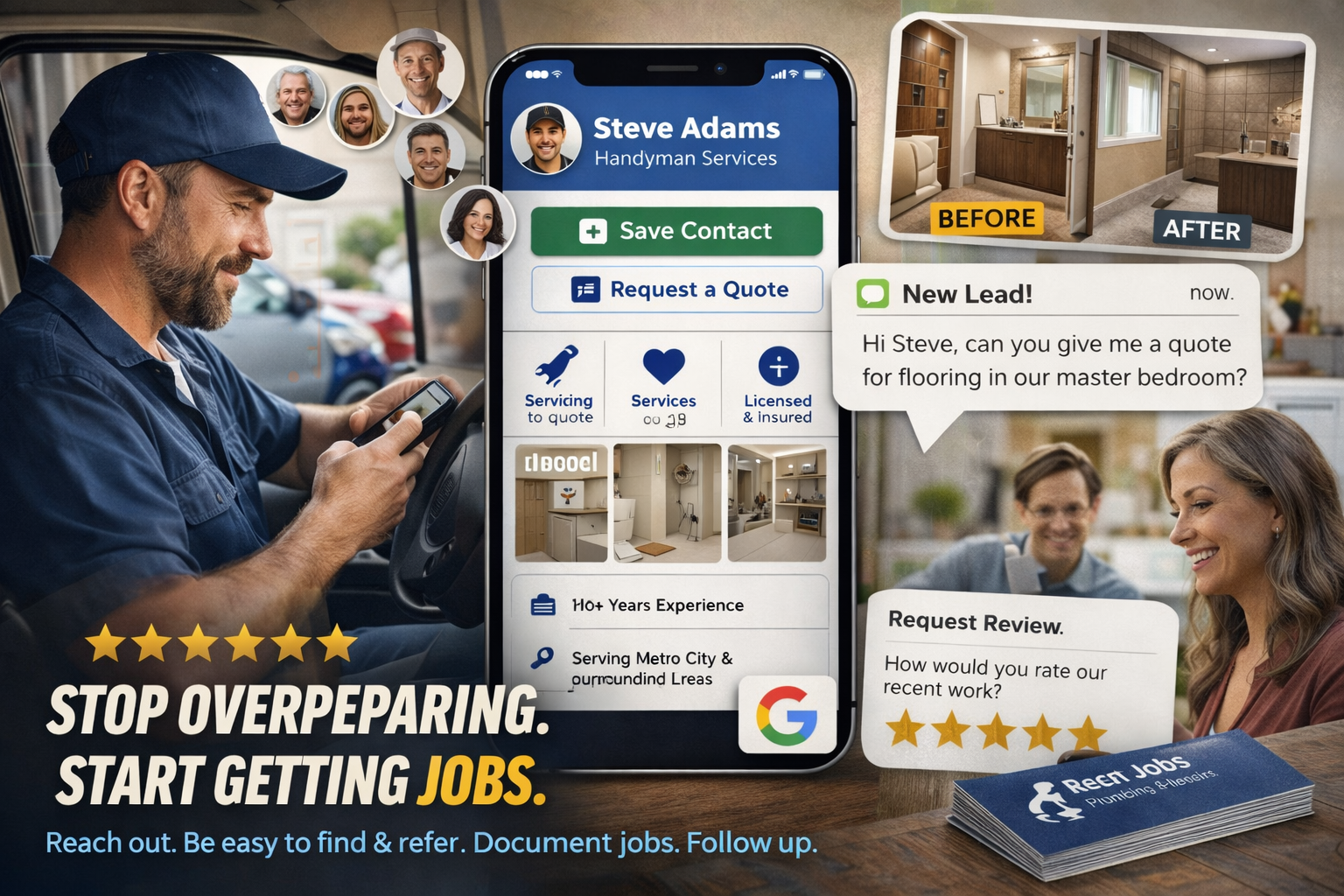
What you actually need is a professional online presence — a single link that works as your website, business card, and lead generator all in one. Somewhere a potential customer can land, see your services, view your work, read a review or two, and contact you. Something you can share in a text message, put on a yard sign, or hand out via QR code.
This is the approach that's quietly replacing traditional websites for most independent contractors. A tool like TradePass gives you a shareable digital business card that functions as a full online presence — complete with your services, photos, reviews, quote request forms, and one-tap calling. No domain to buy. No hosting to manage. No developer to pay.
Key insight
A professional online presence doesn't mean a $3,000 website. It means a link you can share that makes you look legitimate and makes it easy for customers to hire you.
4. Showing Up and Following Through
This sounds obvious, but the bar is on the floor. Ask any homeowner about their experience hiring contractors and you'll hear the same complaints: they don't show up when they say they will, they don't return calls, they disappear mid-job, they leave messes.
As a new contractor, your single biggest competitive advantage is reliability. Show up when you say you'll show up. Return calls within an hour. Clean up after yourself. Send a quick text when you're on the way. These basics will generate more word-of-mouth than any marketing campaign.
- Answer your phone or return calls within one hour
- Show up on time — or text ahead if you're running late
- Send a quick follow-up text after every job asking if they're happy with the work
- Leave the job site cleaner than you found it
5. Documenting Your Work From Day One
Take before-and-after photos of every single job. Every one. Even the small ones. Especially the small ones. A $200 faucet replacement photographed well is more convincing to a potential customer than a description of a $20,000 bathroom remodel with no pictures.
These photos become your portfolio, your social proof, and your marketing material. When someone asks "can you show me examples of your work?" you want to be able to pull up 30 jobs on your phone, not mumble about not having gotten around to it yet.
What You Can Safely Ignore (For Now)
Here's where this article diverges from every other "start a contracting business" guide. These are legitimate business activities that are a waste of time and money in your first year:
A Custom Website
As mentioned above, a website is a long-term play. It requires content, SEO, and time to rank in search results. Until you have 20+ Google reviews and enough cash flow to invest in it properly, a digital business card that doubles as your website will serve you better.
Paid Lead Services
HomeAdvisor, Angi, Thumbtack — these platforms charge $15 to $75+ per lead, and each lead goes to three to five contractors simultaneously. When you have zero reviews on their platform, you're competing against contractors with 200+ reviews and years of presence. The math doesn't work until you have the reputation and cash flow to compete.
Social Media Marketing
Posting on Instagram three times a week will not get you jobs. It might eventually, but in year one, the time you spend creating content would be better spent knocking on doors, following up with past customers, and doing good work. If you enjoy posting, do it — but don't count on it as a lead source.
A Fancy Logo and Branding
A clean, simple logo is fine. Spending $500 on a branding package before you have five customers is not. Your customers care whether you show up on time and do good work. They do not care whether your logo has a gradient.
Business Cards (Paper Ones)
Paper business cards end up in washing machines, junk drawers, and trash cans. They can't be forwarded. They can't be saved to a phone. They don't show your work or reviews. They served a purpose for decades, but there are better tools now.
The Real Startup Checklist for New Contractors
Here's what actually matters, in the order you should do it:
- 1Get your license and insurance sorted (non-negotiable, do this first)
- 2Set up a Google Business Profile (free, helps you show up in local searches)
- 3Create a digital business card that works as your website (services, photos, contact info, quote form)
- 4Tell everyone in your personal network you're open for business
- 5Do your first jobs at a fair price, even if the margins are thin — you're building a reputation
- 6Take before-and-after photos of every job
- 7Ask every satisfied customer for a Google review
- 8Follow up with every past customer 30 days after the job
- 9Make it effortless for customers to share your info with friends and neighbors
- 10Reinvest in better tools and marketing only after you have consistent work
Notice
Notice what's not on this list: a website, paid ads, social media strategy, CRM software, or a branding agency. Those come later. This list is about getting your phone ringing.
How to Build Your Reputation Before You Have One
The catch-22 of starting out is that customers want to see reviews and a track record, but you can't get those without customers. Here's how to break the cycle:
- 1Start with people who already trust you — friends, family, neighbors. Do excellent work at fair prices.
- 2Ask every one of them for a Google review. Make it easy by texting them a direct link to your review page.
- 3Photograph the work. Before, during, after. Post it on your digital business card so new prospects can see real examples.
- 4When a customer compliments your work in person, say: "That means a lot — would you mind leaving a quick Google review? It really helps." Most people will say yes if you ask in the moment.
- 5Follow up 2-4 weeks after every job with a simple text: "Hey, just wanted to check in — is everything still looking good with [the work you did]?" This shows you care and keeps you top of mind for referrals.
Within three to six months of consistent work, you can realistically have 15 to 25 Google reviews. That's enough to look established to any new customer who looks you up.
The $2,000 Website Trap
Let's talk about the elephant in the room. Almost every "start a contracting business" article tells you to build a website. Many of them are written by agencies that — conveniently — sell websites.
Here's the reality: a basic contractor website costs $1,500 to $5,000 to build. Then you need hosting ($10-30/month), a domain ($15/year), and someone to update it when things break. If you want it to actually generate leads through Google, you need SEO, which means blog content, backlinks, and usually another $500 to $2,000 per month in agency fees.
For a new contractor with no reviews, no content, and no domain authority, a website will sit on page 47 of Google doing absolutely nothing. Meanwhile, the $3,000 you spent on it could have bought tools, insurance, a vehicle wrap, or six months of a digital business card that actually gets shared with real customers.
This is why more new contractors are skipping the website entirely and using a digital business card as their online presence. A TradePass card gives you a professional page with your services, work photos, customer reviews, a quote request form, and one-tap calling — all in a single link you can share anywhere. It works as your website without the cost, complexity, or SEO dependency.
The best marketing tool for a new contractor isn't the one with the most features. It's the one that makes it easiest for a happy customer to pass your name along.
What to Do This Week
If you're reading this because you're new to contracting and trying to figure out how to get jobs, here's your homework for this week:
- 1Text 20 people you know and let them know what services you offer. Be specific: "Hey, I just started doing [specific service] — if you or anyone you know needs work done, I'd love a shot at it."
- 2Set up your Google Business Profile if you haven't already. It's free and takes 30 minutes.
- 3Create a digital business card with your services, contact info, and any work photos you have. Share the link in your text messages and social media bio.
- 4Take photos of your next three jobs — before, during, and after.
- 5After your next completed job, ask the customer for a Google review. Text them the link to make it easy.
That's it. Five tasks. No budget required. No marketing degree needed. If you do these five things consistently, you will have more work than most contractors who spent thousands on websites and lead services.
The contractors who win in year one aren't the ones with the best marketing. They're the ones who do good work, make it easy for customers to find and share them, and follow up. Everything else is noise until your phone is ringing consistently.
Create My Card — Live in 5 Minutes
A digital business card built for the trades. Customers save your info to their phone, request quotes, and share you with friends. No website needed.