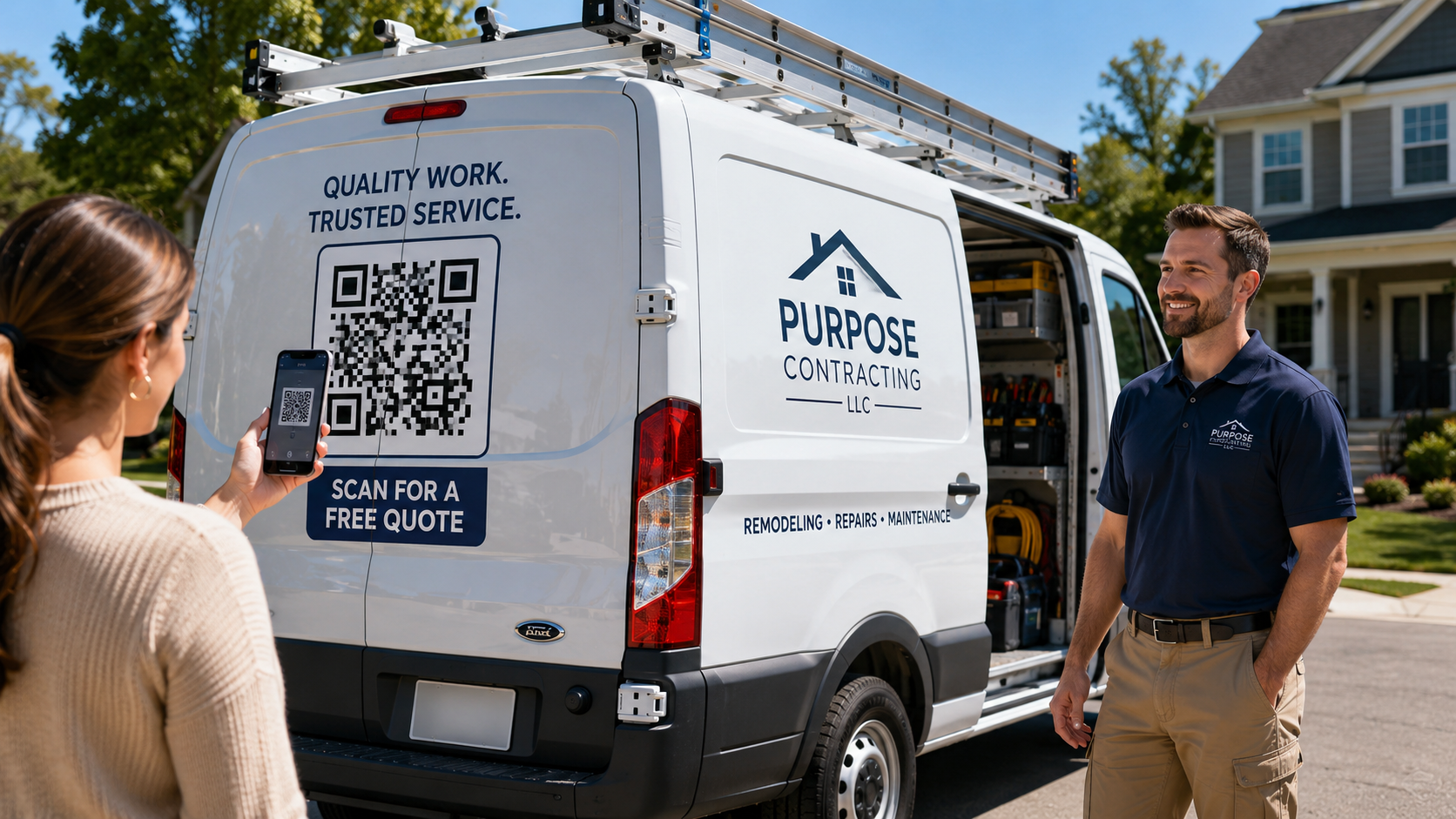
You drive your work van every single day. To jobs, from jobs, to the supply house, through neighborhoods, past hundreds of homes. You park it in driveways while you work. You sit in traffic. You stop at gas stations and coffee shops. Your van is always out there, always visible, always working.
According to the American Trucking Association, a single wrapped vehicle generates between 30,000 and 70,000 impressions per day. That is 400-600 people per mile who see your van, your business name, your phone number. Over a year, that adds up to 12-16 million views.
But here is the question nobody asks: how many of those 30,000+ daily impressions actually turn into leads? How many people who see your van while you are parked in a neighbor's driveway actually call you? How many drivers stuck behind you at a red light actually save your number?
For most contractors, the honest answer is: almost none. And they know it. They paid $3,000-$5,000 for a wrap, it looks great, and they assume it is 'working' in some vague brand-awareness way. But they cannot point to a single measurable lead that came from their vehicle.
The problem is not the wrap. The problem is that seeing a phone number on a van at 35 mph and actually doing something about it are two completely different things. The gap between 'I noticed that plumber's van' and 'I saved that plumber's number' is enormous -- unless you build a bridge across it.
That bridge is a QR code linked to your digital business card. And it changes your van from a passive billboard into an active lead generation machine that you can actually measure.
Why Your Current Van Wrap Is Leaking Leads
Let's trace what happens when someone sees your van right now:
- 1They notice the van (the wrap worked -- they saw you)
- 2They read your business name and maybe your phone number
- 3They think 'I should remember that' or 'I might need a plumber soon'
- 4They keep driving. Or they go back inside their house.
- 530 seconds later, they have forgotten your phone number. 5 minutes later, they have forgotten your business name. By tomorrow, they have forgotten the van entirely.
This is not a failure of attention. It is a failure of conversion. The wrap did its job -- it got noticed. The OAAA and Nielsen research confirms that 97% of people recall vehicle advertisements, which is higher than any other form of outdoor advertising. Your van is being seen. It is being remembered (briefly). But that memory is not converting into action because there is no easy next step.
A phone number on a van requires someone to memorize 10 digits, pull out their phone, and dial -- all while driving or standing in their yard. A website URL requires them to remember it, type it in later, and navigate your site. These are high-friction actions that require motivation the viewer does not have yet.
The core problem
Your van creates awareness. But awareness without a conversion mechanism is just scenery. You need a zero-friction way for interested people to capture your information in the 3-5 seconds they are looking at your vehicle.
The Numbers: What Your Van Is Actually Worth
Before we get into the solution, let's appreciate what you are already sitting on. The data on vehicle advertising is remarkably consistent across multiple studies:
Impressions
- 30,000-70,000 impressions per day (American Trucking Association)
- 400-600 impressions per mile driven
- 12-16 million impressions per year for a vehicle driving in a metro area
- 96% of respondents say vehicle graphics have more impact than billboards (ATA study)
- 91% of people notice vehicle graphics
Cost Effectiveness
- Vehicle wrap CPM (cost per 1,000 impressions): $0.15-$0.48
- Billboard CPM: $3.56
- Radio CPM: $7.75
- Newspaper CPM: $19.70
- TV CPM: $35.00
- Digital ads CPM: $2-$21
Your van delivers advertising at a fraction of the cost of every other medium -- and it does it 24/7 without monthly payments, ad spend, or ongoing effort. A $4,000 wrap that lasts 6 years costs about $1.83 per day. For that $1.83, you are getting exposure that would cost hundreds of dollars per day through any other channel.
Fleet graphics can cost as little as $0.15 per thousand impressions while online ads can cost up to $21 per thousand impressions. And unlike other marketing mediums, vehicle graphics are not subject to ad blockers, commercial-free streaming, or other barriers that prevent brands from communicating with potential customers.
The OAAA found that out-of-home advertising generates nearly 4x more online activations per ad dollar than TV, radio, and print combined. And fleet vehicle advertising boosts name recognition 15x greater than any other form of advertising.
You are already investing in this asset. The question is whether you are extracting 2% of its potential value or 100%.
The QR Code Bridge: How It Works
A QR code on your van changes the conversion equation entirely. Instead of asking someone to memorize a phone number or website URL, you are asking them to do one thing: point their phone camera at a square for 2 seconds.
Here is the updated sequence:
- 1They notice your van (same as before -- the wrap works)
- 2They see a clear QR code with a call-to-action: 'Scan for a free quote' or 'Save my contact'
- 3They pull out their phone (which is already in their hand or pocket) and scan
- 4They land on your digital business card -- your name, photo, trade, phone number, services, credentials, and a quote request form
- 5They tap 'Save Contact' and your complete info is now permanently in their phone
- 6Or they tap 'Request a Quote' and you have a warm lead with their name and project details
The time from noticing your van to having your contact saved in their phone: under 10 seconds. The friction dropped from 'memorize and dial later' to 'point and tap.' That difference is everything.
Why QR Codes Work Now (When They Did Not Before)
If you tried QR codes back in 2015 and nobody scanned them, that was a different era. Here is what changed:
- No app required: Every iPhone and Android phone now has a built-in QR scanner in the default camera app. No downloading a 'QR reader' first.
- COVID accelerated adoption: Restaurant menus, parking meters, and payment systems trained the entire population to scan QR codes without thinking about it.
- 100 million US scanners: Statista projects 99.5 million smartphone users in the US will scan QR codes in 2025. That is roughly one in three Americans.
- 57% year-over-year growth: Global QR scans grew 57% year-over-year according to Wave Connect's 2025-2026 data. Adoption is accelerating, not plateauing.
- Instant results: Modern QR codes load digital content in under a second. No lag, no broken links, no confusion about what to do next.
The behavioral barrier is gone. People scan QR codes now the same way they tap links -- reflexively, without hesitation.
Where to Put Your QR Code (Placement Strategy)
Not all real estate on your van is equal. QR code placement depends on understanding when and where people have both the opportunity to see it and the ability to scan it.
Location #1: The Rear of the Vehicle (Traffic)
This is your highest-volume, highest-conversion placement. When you are stopped at a red light, in slow traffic, or in a parking lot, the driver behind you has 30-90 seconds of idle time staring directly at the back of your van. They are already holding their phone (or it is on the dash). The QR code should be:
- Centered on the rear door or tailgate
- At least 8-10 inches square (larger is better -- you want it scannable from 4-8 feet away)
- High contrast (dark QR on light background or vice versa)
- Paired with a clear call-to-action text above or below it
Location #2: The Sides of the Vehicle (Parked)
When your van is parked in a customer's driveway or on a residential street, the sides are visible to every neighbor, passerby, and dog walker. This is slower, more intentional viewing -- people walking past have more time to notice and scan. The QR code should be:
- At least 10-12 inches square on the sides (people scan from farther away while walking)
- Positioned in the lower-rear quarter of the side panel (eye level for a person standing on the sidewalk)
- Visible when the van is parked close to a curb (not blocked by other vehicles)
- Accompanied by your trade identification and call-to-action
Location #3: Near the Job Site Entry (Bonus)
If you park in a driveway that faces the street, the rear of your van is now a billboard for the entire neighborhood for the duration of your job. Every neighbor who drives or walks past sees it. Some will be curious about what work is being done next door. A visible QR code turns that curiosity into a connection.
Placement priority
If you can only add one QR code, put it on the rear. That is where you get the longest viewing time (traffic stops), the closest proximity (a few feet), and the most consistent attention (drivers with nothing else to look at). Side placements are second priority for parked exposure.
What Your QR Code Should Link To
This is where most people get it wrong. They link their QR code to their website homepage, a Google Maps listing, or even just a phone number. These are all missed opportunities.
Your QR code should link to a digital business card -- a purpose-built mobile page that does four things simultaneously:
1. Identifies You Instantly
Your name, face, trade, and business name. Within one second of scanning, the person knows exactly who they are looking at and what you do. No navigation required, no clicking through pages.
2. Saves Your Contact to Their Phone
A single tap adds your complete contact information -- name, phone, email, trade, business name -- to their phone's contact list. This is the conversion that matters. Once you are in their contacts, you cannot be forgotten. You are searchable. You are shareable. You are permanent.
3. Shows Your Credentials and Work
Your license number, insurance status, years of experience, service areas, and photos of completed work. This builds trust in the 15-30 seconds after the scan. The person went from 'I noticed a van' to 'this person is licensed, experienced, and does quality work' in half a minute.
4. Captures the Lead
A built-in quote request form lets interested people describe their project and submit their contact information right there. No phone tag, no voicemail, no 'I'll call later and forget.' They fill in what they need done, and you receive a lead notification.
A website cannot do all four of these things in under 10 seconds. A digital business card can -- because it is designed specifically for this moment: someone scanned your code and needs to quickly decide whether to save your info or move on.
The goal is not to get them to read your website. The goal is to get them into your phone contacts before they put their phone down. Everything else -- the credentials, the photos, the quote form -- supports that one conversion.
The Call-to-Action: What to Print Next to the QR Code
A QR code without context is just a weird square. People need a reason to scan it. The text you print next to the code is the difference between a 0.5% scan rate and a 5% scan rate.
What Works
- 'Scan for a Free Quote' -- clear value exchange; they get something for scanning
- 'Need Work Done? Scan Here' -- speaks directly to their potential need
- 'Save My Contact' -- simple and direct; tells them exactly what happens
- 'Scan to See Our Work' -- curiosity-driven; appeals to people who want to browse before committing
- 'Text-Free Estimate: Scan Here' -- removes the friction of phone calls for younger homeowners
What Does Not Work
- 'Scan Me' -- tells them nothing about what they get; feels generic
- 'Visit Our Website' -- too vague; no compelling reason to scan now
- No text at all -- most people will not scan an unexplained QR code
- 'Follow Us on Social Media' -- wrong conversion; you want them in your contacts, not scrolling your Instagram
- Your URL only -- if they can read the URL, they do not need the QR code, and most won't type it in anyway
Design Tips for the CTA Area
- Use a contrasting background behind the QR code and text (white or light box on a dark wrap)
- Make the text large enough to read from 4-6 feet away (especially on the rear)
- Keep it to 4-5 words maximum -- this is not a paragraph, it is a billboard
- Add a small phone icon or arrow pointing to the QR code to draw the eye
- Consider a simple frame or border around the QR code to separate it from busy wrap graphics
Making It Trackable: Measuring Your Van's Performance
One of the biggest advantages of QR-code-equipped vehicle advertising over traditional wraps is measurement. With a standard wrap, you have no idea which leads (if any) came from your vehicle. With a trackable QR code setup, you can see exactly how many people scan, when they scan, and what they do after scanning.
What You Can Track
- Total scans per day/week/month -- your van's actual lead generation volume
- Time of day scans happen -- tells you when your van is most visible and generating interest
- Geographic patterns -- if your digital card shows view locations, you can see which neighborhoods respond most
- Quote requests submitted -- direct leads attributable to your vehicle
- Contacts saved -- how many people added you to their phone from the QR scan
- Repeat views -- people who come back to your card days or weeks later (intent signal)
For the first time, your vehicle wrap becomes a measurable marketing channel instead of a faith-based investment. You can compare your van's monthly lead generation to your other sources (Google ads, referrals, door knocking) and make informed decisions about where to invest more.
If your brand does not instantly read as premium and clear on a truck at 30 mph, you are paying a tax on every channel.
Antonelli's firm has documented case studies where contractors doubled and tripled revenue after rebranding their vehicles -- but even the best wrap design is leaving value on the table without a conversion mechanism. The QR code is that mechanism.
The Parked Van Effect: Your Silent Salesperson
Here is a scenario that happens dozens of times per week for most contractors: you park your van in a customer's driveway and spend 2-6 hours working. During that time, neighbors see your van. Some are curious about what work is being done. Some have been thinking about getting similar work done themselves. Some have a project they have been putting off.
Without a QR code, those neighbors have one option: interrupt you on the job site (awkward and unlikely) or try to remember your business name and look you up later (even more unlikely). With a QR code on the side of your van facing the street, they can scan from the sidewalk, save your info, and request a quote -- all without ever talking to you.
This is the parked van effect. Your vehicle becomes a silent salesperson working the neighborhood while you work the job. Every hour you spend at a job site is an hour your van spends generating leads from the surrounding homes.
Maximizing the Parked Van Effect
- Park with your QR-code side facing the street whenever possible
- If you have a choice of driveways (e.g., circular drive), park where your van has maximum street visibility
- On multi-day jobs, your van's presence in the neighborhood compounds -- people see it day after day and eventually get curious enough to scan
- After completing a job, leave a few physical business cards with QR codes on them for the customer to hand to curious neighbors
Some contractors report that their best leads come not from the customer who hired them, but from the neighbors who saw their van parked nearby for days. A well-placed QR code makes those 'curious neighbor' leads automatic instead of accidental.
The Red Light Window: 30-Second Conversions
The average red light in the US lasts 45-120 seconds. During that time, the driver behind you has nothing to do but look at the back of your van. Their phone is within reach. They are stationary. This is the perfect scanning opportunity.
The rear QR code paired with a clear call-to-action ('Need a Plumber? Scan for Free Quote') converts idle traffic time into leads. Even at a conservative scan rate, consider the math:
The Math
Let's use conservative numbers:
- Your van stops at roughly 15-25 red lights per day
- At each light, 2-5 vehicles are behind you
- That is 30-125 close-range rear impressions per day from traffic stops alone
- Even at a 1% scan rate, that is 1-2 scans per day just from red lights
- Over a month: 20-40 new contacts who saved your info from traffic alone
- Over a year: 240-480 people who have you permanently in their phone -- and a portion of those will need your services at some point
These are not cold leads from an ad. These are people in your service area who voluntarily saved your contact because they have some level of interest or anticipated future need. When their water heater fails or their outlet stops working six months from now, guess whose name pops up when they search their contacts?
Real-World Results: What Contractors Are Seeing
The vehicle-wrap-plus-QR-code strategy is still relatively new for tradespeople, which means early adopters have a significant advantage. Here is what the data shows:
Industry Benchmarks
- Out-of-home QR campaigns show a 2.9% response rate in multi-city tests (Gitnux 2026 Report) -- significantly higher than digital display ads at 0.1-0.5% CTR
- Wrapify tracked that wrapped vehicles boosted online conversion rates by 20% for exposed audiences
- Small businesses report up to 800% ROI over a vehicle wrap's lifespan (Davis Signs & Graphics, 2024)
- KickCharge Creative documented contractors doubling revenue within a year of vehicle rebrand -- including one HVAC company that went from $77K to $1.9M in 6 months after bold rebranding that included distinctive fleet wraps
The Attribution Advantage
Before QR codes, contractors would ask new leads 'How did you hear about us?' and get unreliable answers. People forget. They attribute their discovery to Google even if they first saw your van. They say 'a friend referred me' when really they scanned your code in traffic and then checked your Google reviews.
With a trackable digital card behind your QR code, you know exactly which leads came from scans. You can see the timestamp, the rough location (traffic vs. parked neighborhood), and whether they just browsed or submitted a quote request. This data tells you whether your van is working and how well.
Implementation Guide: From Nothing to Generating Leads in One Weekend
You do not need a full vehicle wrap to start generating leads from your van. Here is how to get set up quickly at every budget level.
Level 1: Minimum Viable (Under $100)
Get started this weekend:
- 1Set up your digital business card with your photo, services, credentials, phone number, and quote request form
- 2Generate your QR code that links to your card
- 3Print the QR code as a weatherproof vinyl sticker (8x8 inches minimum) -- available from any local sign shop or online print service for $15-30
- 4Apply the sticker to the rear of your vehicle with a call-to-action: 'Scan for Free Quote' or 'Save My Contact'
- 5Add a second sticker to the driver or passenger side (whichever faces the street when you park)
Total cost: Under $100. Time to implement: One afternoon. You are now generating trackable leads from every traffic stop and every job site.
Level 2: Professional Integration ($300-$800)
If you already have a wrap or are getting one designed:
- 1Work with your wrap designer to integrate the QR code into the overall design
- 2Request a dedicated 'scan zone' -- a high-contrast area (usually white or light background) that separates the QR code from busy graphics
- 3Ensure the QR code is at least 10 inches square on the sides and 8 inches on the rear
- 4Include your call-to-action as part of the designed layout so it looks intentional, not stuck on as an afterthought
- 5Add a small explanatory line: 'Point your phone camera here' for older demographics who may not be familiar with QR scanning
Level 3: Full Optimization ($3,000-$7,000)
For a new wrap designed from scratch with lead generation as a primary goal:
- Design the rear panel as a dedicated lead capture zone: large QR code, clear CTA, high contrast, minimal clutter
- Include QR codes on both sides with slightly different CTAs ('Save My Contact' on one side, 'Get a Free Quote' on the other) to test which converts better
- Use a simple, bold color scheme that makes the QR code and text scannable at various distances and in different lighting conditions
- Consider a QR code with your logo or brand color embedded in the center (modern QR generators allow this while maintaining scan reliability)
- Include your phone number and digital card URL as fallbacks for people who cannot or will not scan
Mistakes That Kill Your Scan Rate
These are the most common mistakes contractors make when adding QR codes to their vehicles:
QR Code Too Small
A 3-inch QR code on the side of a van is unscannable from more than 2 feet away. Phones need a certain minimum resolution to read the code. Go bigger than you think -- 8 inches minimum on the rear, 10-12 inches on the sides. It should be obvious, not hidden.
Low Contrast
A dark QR code on a dark wrap background is invisible. A white QR code on a light wrap disappears in sunlight. You need stark contrast: dark code on white/light background, or white code on very dark background. Give the QR code its own dedicated space with a contrasting background rectangle.
No Call-to-Action
People will not scan a random square with no context. Always include text explaining what happens when they scan. The CTA does two things: it tells people what the square is (for those who somehow do not recognize QR codes) and it gives them a reason to scan (the value they get).
Linking to the Wrong Destination
If someone scans your code and lands on a cluttered website homepage with 15 navigation links, you have lost them. The scan destination needs to be instant, mobile-optimized, and single-purpose: save contact, request quote, see credentials. A digital business card is purpose-built for this. A website is not.
Placing the Code Where It Cannot Be Scanned
A QR code on the roof rack is useless. A QR code on the front bumper is never seen (drivers are behind you, not in front). A QR code inside the wheel well is obviously absurd -- but the principle applies to less obvious bad placements too. Think about where people actually view your van from and at what distance.
Beyond the Van: Multiplying the Strategy
Once you see results from your van's QR code, the same strategy extends to every physical surface you control:
Yard Signs
The traditional 'Joe's Plumbing' yard sign that sits in a customer's lawn during a multi-day job. Add a QR code and it becomes a lead capture tool for every neighbor and passerby who walks their dog past the house.
Job Site Signage
A small corrugated sign at the street-facing edge of a job site: 'Renovation by [Your Name] -- Scan for Free Estimate on Your Project.' Costs $5-10 per sign and works the entire duration of the job.
Business Cards
Your physical business card should have the same QR code on the back. When you hand someone a card, the QR code bridges them from a losable piece of paper to a permanent phone contact -- the same conversion mechanism as your van, just at closer range.
Invoices and Leave-Behinds
Every invoice, receipt, or door hanger you leave includes the QR code with 'Save my contact for future work.' Each one becomes a mini lead-gen tool rather than just paperwork.
Email Signatures
Include a small QR code image in your email signature for digital correspondence. Anyone you email can scan to save your contact without manually typing your information.
The Compound Math: Why This Changes Your Business
Let's project what happens over 12 months with a QR-equipped van, using conservative assumptions:
- You drive to 4-5 jobs per day, 5 days per week
- Your van is visible at roughly 20 traffic stops per day
- Your van is parked at job sites for an average of 3 hours per job, visible to the neighborhood
- Conservative estimate: 2-3 QR scans per working day from all sources combined
- That is 10-15 new saved contacts per week
- Over a month: 40-60 new people have you in their phone
- Over a year: 500-700 people in your service area have your complete contact info saved permanently
Now: what percentage of those 500-700 people will need your services at some point? What percentage will get asked 'do you know a good [your trade]?' by someone else? Even at a 5-10% conversion rate over time, that is 25-70 jobs per year that are directly attributable to your van's QR code.
At an average job value of $500-$2,000, that is $12,500 to $140,000 in additional revenue from a strategy that cost you under $100 to implement.
Compare that to what you are getting from your van without a QR code: probably zero trackable leads. The wrap cost the same either way. The van is driving the same routes either way. The only difference is whether you are capturing value from all those impressions or letting them evaporate.
Vehicle advertising reaches more consumers at a lower cost per thousand impressions than any other form of advertising.
You already own the advertising medium. You already have the impressions. You are just not converting them. The QR code is the missing piece that turns 30,000 daily impressions into an actual pipeline of leads.
Your Action Plan: This Weekend
Do not overthink this. The contractors who wait for the 'perfect' wrap redesign lose months of leads they could be capturing right now. Start with the minimum and optimize later.
Saturday Morning (1 hour)
- 1Set up your digital business card if you do not have one yet. Add your photo, trade, phone, service area, credentials, and turn on the quote request form.
- 2Generate your QR code. Test it with your phone to make sure it loads your card instantly.
- 3Write your call-to-action: pick one from the list above or write your own in 4-5 words.
Saturday Afternoon (30 minutes)
- 1Order weatherproof vinyl QR code stickers from a local sign shop or online printer (usually same-day or next-day turnaround locally). Get at least 3: one for the rear, one for each side.
- 2While you wait for stickers: clean the areas of your van where they will go. Surface must be clean and dry for vinyl adhesion.
Sunday or Monday (15 minutes)
- 1Apply stickers: rear center at eye level, sides in lower-rear quarter.
- 2Test scan from 3 feet, 5 feet, and 8 feet away to confirm readability at each distance.
- 3Take a photo of your van with the QR codes visible -- you will want this for your 'before' baseline.
By Monday morning, every traffic stop, every job site, and every neighborhood you park in is generating trackable leads. Total investment: under $100 and a few hours of your weekend. Potential value: thousands of dollars per year in leads that would otherwise vanish into the atmosphere.
Your van was always working for you. Now you can prove it -- and multiply it.
Create My Card — Live in 5 Minutes
A digital business card built for the trades. Customers save your info to their phone, request quotes, and share you with friends. No website needed.