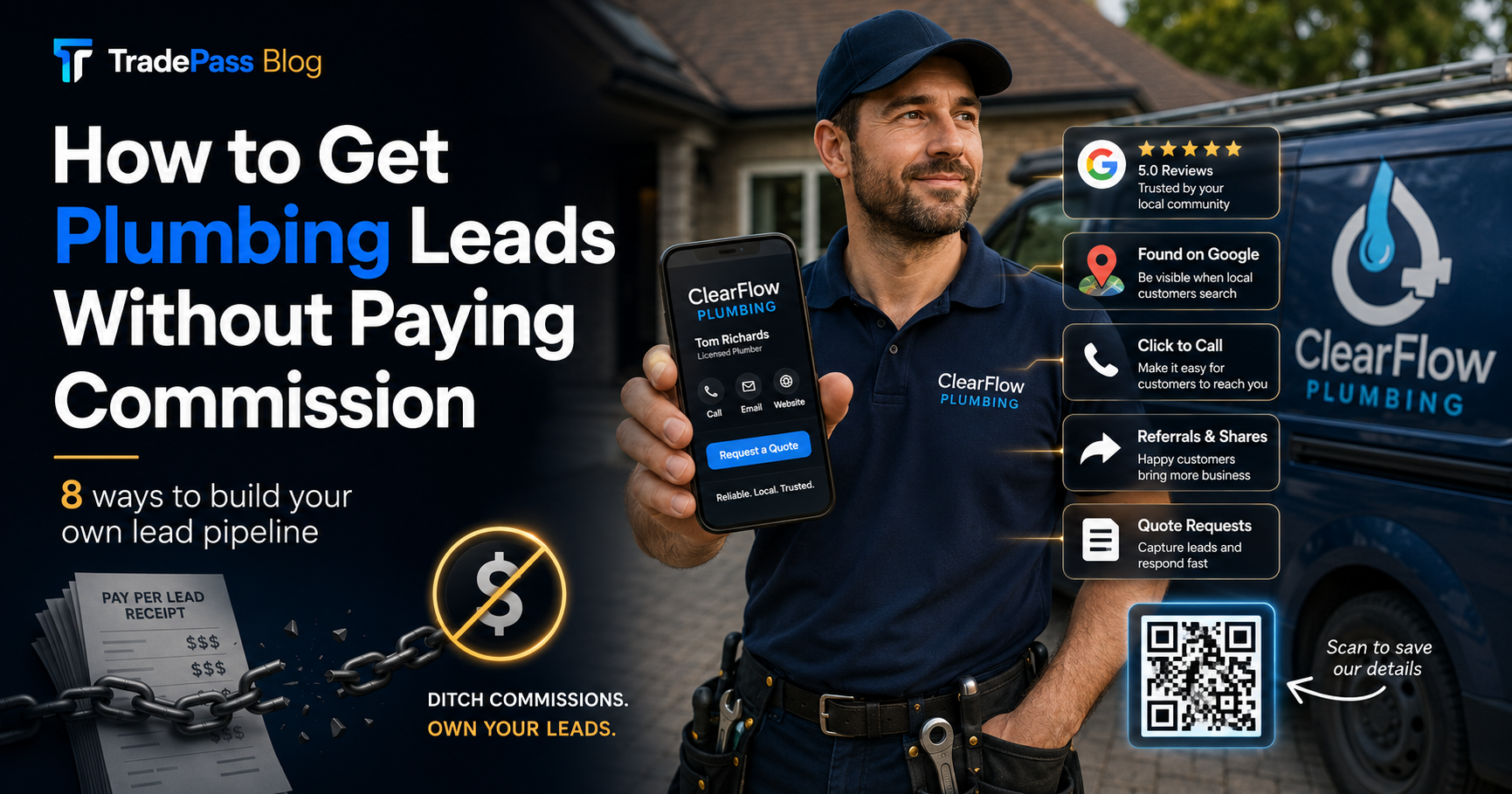
You claim a lead on Thumbtack. You pay $30-80 depending on the job type. You drive 30 minutes to quote the job. The homeowner tells you two other plumbers are already quoting. You spend 20 minutes measuring, explaining, and writing up a price. You send it through. You never hear back.
That lead cost you $30-80 in platform fees plus an hour of your time. Multiply that by the 2-3 leads you lose for every one you win, and you are spending $150-350 in real costs for every job you actually land through a platform. And when you do win, the customer thinks of you as the Thumbtack plumber — not their plumber. Next time they need work done, they post another job on the platform instead of calling you directly.
This is the lead platform trap. You pay for leads. You compete against other plumbers. You win some, lose most. The platform keeps the customer relationship. And next year, the lead prices go up 15-20% because they can.
There is a better way. The plumbers who stay consistently booked without bleeding money to platforms have built their own lead pipelines — systems that generate exclusive calls from customers who already want to hire THEM, not whoever is cheapest on a listing site.
Here are 8 proven methods to get plumbing leads without paying commission to anyone.
The Real Cost of Lead Platform Dependence
Before diving into the alternatives, let us quantify what platforms actually cost a working plumber:
- Thumbtack: Pay-per-lead model. Plumbing leads cost $20-80 each depending on job type and your metro area. You pay just to send a quote — whether you win the job or not. Leads are shared with up to 5 professionals.
- Angi (formerly HomeAdvisor): Charges $15-85 per lead depending on the service. Annual spend requirements in some categories. Leads are shared with multiple contractors simultaneously.
- Yelp for Business: Costs $300-1,000+/month for enhanced listings and lead features. You compete against every plumber with good reviews in your area.
- Google Local Service Ads: $25-75 per lead for plumbing. Better quality than most platforms because customers see your reviews, but still a pay-per-lead model you do not own.
- Google Ads (self-managed): $45-120 per lead for plumbing keywords, higher in competitive metros like LA, NYC, or Dallas.
Industry data from 2025-2026 shows plumbing lead costs increased 21% year-over-year while conversion rates dropped 12%. The economics are getting worse, not better. Meanwhile, customers acquired through reviews and referrals close at 45-65% — versus 8-15% from cold advertising channels.
The math is clear: a customer who calls you because their neighbor recommended you is 4-5x more likely to become a paying job than one who found you on a lead platform. And that referral cost you nothing.
I love businesses that have been around 30 years. They are like, we do not believe in Google, and they get 30, 40 calls a day because they got stickers, they got repeat business, they are big in the community. We build a fence around the customer... it is a repeat customer. You might not need one three years from now, but eventually you are going to say it is time. So we are playing the long game.
1. Google Business Profile — The Free Lead Machine
Your Google Business Profile is the single highest-ROI marketing asset a plumber can own. It is free, it appears in Google Maps above paid results, and it captures customers at the moment of highest intent — when their pipe is leaking and they need someone now.
Here is how to optimize it for maximum calls:
- 1Claim and verify your profile if you have not already (this takes 5-7 days by postcard or instant verification by video)
- 2Set your primary category to Plumber and add secondary categories for every service you offer (Emergency Plumber, Drain Cleaning Service, Water Heater Installation Service, Gas Plumber)
- 3Write a 750-character description naming every service you offer and every area you cover — Google pulls this into AI search summaries
- 4Add 20+ high-quality photos of your work (before and after shots, you in uniform, your van, completed installations)
- 5Add your service areas by city and neighborhood name — be specific, not just your county
- 6Enable messaging and call tracking so customers can reach you directly from the listing
- 7Post weekly updates showing recent jobs — this signals to Google that your business is active and keeps you in the local 3-pack
The reviews are what make this work. Plumbers with 50+ reviews and a 4.7+ rating dominate the local map pack. Every single job you complete is a review opportunity. More on this below.
2. Review Generation System — Turn Every Job Into Future Leads
Reviews are the compounding asset that separates plumbers who stay booked from those who chase leads. Every review you collect makes your Google listing more visible, which brings more calls, which gives you more review opportunities. It is a flywheel.
The system is simple:
- 1Finish the job and confirm the customer is happy
- 2While still on site (or within 2 hours), send them a text message with a direct link to your Google review page
- 3Make the message personal: Hey Sarah, glad we got that leak sorted before it caused any damage. If you have 30 seconds, a Google review would really help my business — here is the link.
- 4If they do not leave one within 48 hours, send one gentle follow-up: No pressure at all, but if you had a moment to leave a quick review I would really appreciate it. Here is the link again.
- 5Never incentivize reviews (violates Google policy) — just make it easy and ask at the right moment
Plumbers who follow this system consistently get a review on 30-40% of jobs. At 3-4 jobs per day, that is 4-6 new reviews per week. Within 3 months you will have more reviews than 90% of plumbers in your area — and Google will reward you with visibility.
3. Van and Vehicle Marketing — Passive Leads Every Day
Your van is parked on residential streets 6-8 hours a day. Every minute it sits there, neighbors walk past, drive past, or look out their window. A well-branded van with a clear QR code and phone number generates leads while you work.
What works on a plumber van in 2026:
- Large phone number — readable from 60+ feet away. This is still the highest-converting element.
- QR code — links to your digital business card or Google profile. Make it large enough to scan from 10-15 feet (minimum 6 inches x 6 inches).
- One clear service statement — not a list of 20 services. Something like: Blocked drains fixed today or Emergency plumber — call anytime.
- Your Google rating — if you have 4.8 stars and 100+ reviews, display it. Social proof visible from the street.
- Your service area — if you serve a specific neighborhood or city, put it on the van. Locals notice when they see their town name.
The QR code is the modern upgrade. A neighbor sees your van, scans the code, and saves your details to their phone. Six months later when they need a plumber, your name and number are already in their contacts. That lead cost you nothing.
4. The After-Job Referral System — Zero Cost, Highest Quality
Referral leads close at 45-65%. They do not price-shop. They trust you before you arrive because someone they know vouched for you. And they cost zero dollars. The only reason most plumbers do not get more referrals is they do not have a system — they rely on customers remembering to recommend them.
Here is a system that works without being pushy:
- 1After completing a job, show the customer your digital business card QR code and ask them to save your contact
- 2Say something natural: Hey, I appreciate your business. If any of your friends or neighbors ever need a plumber, just forward my card to them — it has my number, what I do, everything.
- 3Leave a QR code sticker in a discreet but visible spot near your work — under the sink, on the water heater, inside the electrical panel cover
- 4Follow up 3-5 days later with a text: Hi Sarah, just checking everything is running well after the repair on Tuesday. Let me know if anything comes up.
- 5That follow-up text does two things: it shows you care (which builds loyalty), and it reminds them you exist (which triggers referrals)
The sticker strategy is particularly powerful for plumbers. Every plumber, tenant, or homeowner who opens that utility closet or looks under that sink in the future sees your QR code and name. It is a permanent, passive lead generator installed at every job you complete.
5. Digital Business Card — Make Referrals Effortless
Paper business cards fail plumbers for a simple reason: they get wet, crumpled, or lost. And even when a customer keeps your card, they cannot forward it to a friend without physically handing it over.
A digital business card solves both problems. Your details are saved permanently in the customer phone, and they can share your card with anyone in one tap — via text, iMessage, or just showing the QR code.
For plumbers, the most effective digital card includes:
- Tap-to-call button — customers call you with one touch, no typing your number
- Quote request form — potential customers describe their plumbing issue and request a callback
- Service list — so referrals can confirm you do the type of work their friend needs
- Google reviews display — social proof that converts unsure leads into callers
- Service area — neighborhoods and cities you cover, so people know you work in their area
- Photo gallery — before and after shots of your best work
- QR code — for your van, invoices, stickers, and email signature
The quote request form is the key differentiator from a paper card. Instead of just seeing your phone number, potential customers can describe their problem (blocked drain in the kitchen, water heater not heating, need a gas line for new BBQ) and request a callback. You receive an actionable lead — not just a name and number, but the specific job they need done.
6. Email Signature and Invoice Footer — Every Message Becomes a Lead
Every email you send — quotes, invoices, appointment confirmations — can include a link or QR code to your digital profile. This turns routine business communication into a passive lead channel.
Where to add your digital card link:
- Email signature — every reply to a customer inquiry includes your card
- Invoice footer — when they open your invoice in 6 months to find a plumber again, your link is right there
- Quote PDFs — even if they do not accept your quote now, they have your card saved for future work
- Appointment confirmation texts — a natural place to include your link
- Post-job follow-up messages — the thank-you text includes your shareable card
This costs nothing extra and requires zero ongoing effort once set up. Every communication touchpoint becomes a potential future lead or referral.
7. Strategic Google Ads (When Ready) — Own Your Leads
Once your Google Business Profile is generating consistent organic calls, Google Ads can amplify your visibility. The difference between Google Ads and lead platforms: you own the customer relationship. They call you directly, no middleman, no competing quotes, no commission.
Plumbing Google Ads done right:
- Google Local Service Ads (LSAs) — these appear above regular ads, show your Google rating, and you only pay for actual calls. Cost per lead is 40-60% less than traditional Google Ads.
- Target emergency and high-intent keywords: emergency plumber [city], clogged drain plumber near me, burst pipe repair today
- Set a daily budget you are comfortable with ($30-50/day is a solid starting point) and adjust based on results
- Track which calls convert to jobs — most plumbers find their cost per won job from LSAs is $80-150, significantly less than platform leads
- Pause during periods when you are already fully booked — unlike platform subscriptions, you control the spend daily
The key advantage: every customer you acquire through your own ads can become a repeat customer and referral source. They are YOUR customer, not the platform customer. That compounds over years.
8. Neighborhood Presence — Be the Known Plumber
The most powerful lead source for any local plumber is simple recognition. When someone in your service area thinks plumber, you want your name to come to mind before they ever open Google or a lead platform.
How to build neighborhood presence:
- Work the same neighborhoods consistently — density beats spread. Being the plumber everyone in Oakwood or Riverside knows is more valuable than covering 50 zip codes thinly.
- Leave a QR code sticker at every job (with permission) — over time, homes throughout the neighborhood have your details
- Introduce yourself to neighbors when working on a street — not a hard sell, just: Hey, I am [name], just doing some plumbing work next door. Here is my card if you ever need anything.
- Offer a preferred rate for the street or building — word travels fast in apartments and HOA communities
- Sponsor a local sports team or school event — $200-500 per season gets your name on jerseys seen by hundreds of local families
- Post your completed jobs on a local community Facebook group or Nextdoor — with permission, share before and after photos. This is free advertising to exactly your target market.
This strategy takes 6-12 months to compound, but the result is powerful: you become the default plumber for an entire neighborhood, and every new job reinforces your reputation. Customers call you directly, never knowing lead platforms exist.
The Transition Plan: Moving Off Platforms Without Losing Work
You do not need to quit lead platforms cold turkey. The smart approach is a gradual transition that builds your direct channels while maintaining income:
- 1Month 1-2: Optimize your Google Business Profile completely. Start asking every customer for a review. Set up your digital business card and add it to your email signature and invoices. Put a QR code on your van if you have not already.
- 2Month 3-4: You should start seeing 3-5 calls per week from Google and referrals. Every platform lead you win becomes a referral opportunity — make sure you capture them into your own system, not just the platform.
- 3Month 5-6: Reduce your platform spend by 25-30%. The direct calls should be growing to fill the gap. Start Google LSAs if your budget allows.
- 4Month 7-9: Your Google reviews should be 40-60+ by now, generating consistent daily visibility. Reduce platform spend by another 25%.
- 5Month 10-12: Most plumbers at this stage report 50-70% of work coming from direct channels. Maintain a minimal platform presence for overflow or quiet periods, but your dependency is broken.
The key mindset shift: every job is an investment in future leads, not just revenue today. The plumber who finishes a job and asks for a review, shares their card, leaves a sticker, and follows up in 3 days is building a compounding asset. The plumber who finishes and drives to the next Thumbtack lead is renting their future.
What Your Commission-Free Lead System Looks Like
When all eight methods are working together, here is what a typical week looks like for a plumber who has built their own pipeline:
- Monday: 2 calls from Google Business Profile (emergency clogged drain, water heater replacement inquiry)
- Tuesday: 1 referral via forwarded digital card (neighbor of last week customer needs faucet replacements)
- Wednesday: 1 quote request through your digital card QR code (scanned from your van by a homeowner)
- Thursday: 1 call from Google Maps (searched plumber near me, called you because of your 4.9 star rating and 87 reviews)
- Friday: 1 repeat customer (serviced their property 8 months ago, now needs gas line for new cooktop) + 1 referral from their real estate agent
That is 7 leads in a week. All exclusive to you. Zero competition. Zero commission. Zero per-lead fees. The customers already trust you before you arrive. Close rates of 60-80% because they are warm, referred, or chose you specifically.
Compare that to spending $50-100 per week on Thumbtack credits, claiming 5-7 leads, and winning maybe 2 of them while competing on price against other plumbers. That is $2,500-5,000 per year in platform fees alone — before you account for the time spent quoting jobs you never win.
The Bottom Line
Lead platforms are not evil — they serve a purpose, especially when you are starting out and need volume. But building a business that depends on them is building a business you do not fully own. The platform controls your lead flow, your pricing, and your customer relationships.
The plumbers who build long-term, profitable businesses all reach the same conclusion: the best leads are the ones that come to you directly, exclusively, and free. That requires building systems — Google reviews, referral mechanics, van marketing, digital presence — that compound over time.
Start with the highest-impact, lowest-effort changes: optimize your Google Business Profile today, ask your next 5 customers for reviews, and set up a digital business card you can share after every job. Those three actions alone will start generating commission-free leads within weeks.
Create My Card — Live in 5 Minutes
A digital business card built for the trades. Customers save your info to their phone, request quotes, and share you with friends. No website needed.