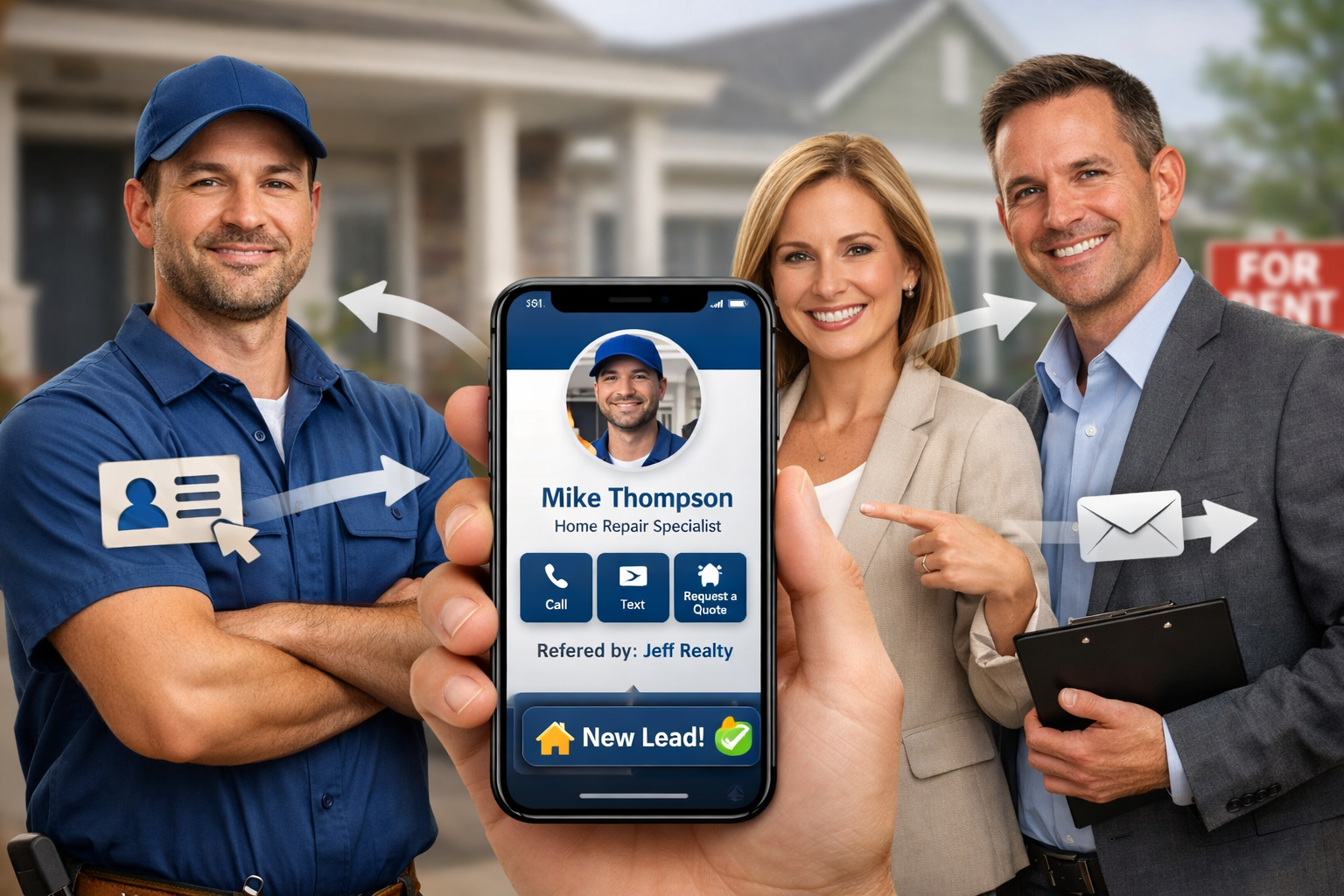
You finished the job. The homeowner loved it. They said they would tell everyone about you. And then... nothing. No calls. No texts. No new work from that glowing review.
Here is the frustrating part: referrals do work. 47% of homeowners say they first heard about the contractor they hired through a referral from a friend, family member, or neighbor, according to a study of 1,600 homeowners by DW Creative. So the leads are out there — the problem is that most contractors sit back and hope those referrals happen on their own. They rarely do. The homeowner means well, but life gets busy, and your name slips their mind the moment someone asks.
This guide is not about asking happy customers to "spread the word." It is about building deliberate, trackable relationships with realtors, property managers, and complementary contractors — the people who can send you a steady stream of high-quality leads month after month, without you spending a dollar on ads.
Why Referral Partners Are Your Most Valuable Lead Source
Not all leads are created equal. A referral from a trusted realtor or property manager is fundamentally different from a cold lead off a website — and the data proves it.
The Numbers Behind Referral Leads
The Association of Professional Builders' 2024 SORCI Report found that 48.7% of builders rely on referrals for more than half of their sales. And it is not hard to see why when you look at the economics:
- Referral leads convert at 35-40%, compared to just 3-5% for paid display ads (Siana Marketing, 2026)
- Referral leads cost roughly $52 on average, versus $135 for HomeAdvisor/Angi and $128 for Google Ads (Siana Marketing, 2026 Cost Per Lead Benchmarks)
- Referred customers have a 16% higher lifetime value than non-referred customers, according to a Wharton School of Business study published in the Journal of Marketing
- Referrals close 69% faster than cold leads (Finances Online)
- Builders need only 1-3 referrals to close a contract, while 41.1% need 1-50 paid leads to close the same deal (Association of Professional Builders, 2024)
Key Takeaway
Dollar for dollar, referral leads cost roughly 60% less, convert at 7-10x the rate, close faster, and produce customers who stick around longer. No other marketing channel comes close.
Why Realtors and Property Managers Send Better Referrals Than Homeowners
When a satisfied homeowner recommends you, that is great — but it is a one-time event. They might refer you once or twice over several years. A realtor, on the other hand, closes dozens of transactions a year. Every buyer needs a home inspector, a plumber, an electrician, a handyman, a painter. Realtors are repeat referral machines by the nature of their work.
Property managers are even more consistent. They manage ongoing maintenance across entire portfolios of rental properties. When a tenant reports a leaky faucet or a broken outlet, the property manager does not search Google — they call the contractor they trust. If that contractor is you, you have recurring work built into their operations.
The critical difference: a homeowner refers you because they liked your work. A realtor or property manager refers you because their reputation depends on it. That means the leads they send are pre-sold on your quality before you ever pick up the phone.
92% of consumers trust recommendations from friends and family over any other form of advertising. When that recommendation comes from a trusted professional like their realtor, the trust is even higher. — Nielsen Global Trust in Advertising Report
Who Makes the Best Referral Partner (And How to Find Them)
Building a referral network starts with identifying the right people. You want partners who regularly interact with homeowners who need your services — and who have an incentive to recommend someone reliable.
The Five Best Referral Partner Types for Contractors
- 1Real estate agents — Every home sale triggers a wave of repairs, upgrades, and renovations. Buyer agents need contractors for pre-move-in work. Listing agents need them for pre-sale improvements. NAR data shows that 20% of an agent's business comes from repeat clients and 21% from referrals, so they deeply understand the value of reciprocal relationships.
- 2Property managers — They manage ongoing maintenance needs across multiple properties. Emergency repairs, tenant turnovers, seasonal maintenance — they need contractors they can call on short notice who show up reliably.
- 3Complementary contractors — A plumber does not compete with an electrician. A roofer does not compete with a painter. Building referral partnerships with non-competing trades means you send each other work naturally. The customer already trusts whoever recommended you.
- 4Home inspectors — They see every problem in a house but cannot fix any of them. When a buyer's inspection reveals electrical issues, plumbing concerns, or general repair needs, the inspector is often asked "Who should I call?"
- 5Insurance adjusters and restoration companies — After water damage, fire, or storm events, adjusters coordinate repairs. Restoration companies handle the emergency work and often need to hand off follow-up trades.
How to Find Partners in Your Area
You do not need to attend expensive networking events or join a chamber of commerce to find referral partners (though those can help). Start with these practical approaches:
- Search for top-producing realtors in your service area. Look at Zillow, Realtor.com, or your local MLS for agents who close the most deals. High-volume agents have the most referrals to give.
- Check Google Maps for property management companies. Focus on small to mid-sized firms managing 50-500 units — they are large enough to have steady work but small enough to value a personal relationship with their contractors.
- Ask your current customers. When you finish a job, ask the homeowner who their realtor was, who manages their rental properties, or if they know any other contractors. Warm introductions are always stronger than cold outreach.
- Connect with contractors you see on job sites. If you are at a renovation and another trade is working there, introduce yourself. That is a natural referral partner waiting to happen.
- Check local BNI or similar networking groups. BNI data shows that referrals from members convert to revenue 55% of the time, significantly higher than other lead sources.
How to Approach Realtors and Property Managers (Without Being Pushy)
The biggest mistake contractors make when trying to build referral relationships is leading with "send me work." Nobody responds to that. You need to lead with value and make it easy for them to say yes.
What Realtors Actually Want from a Contractor
A Clever Real Estate survey found that 25% of homeowners cite reputation as the most important factor when choosing a contractor, followed by experience (23%) and cost (19%). Realtors weight these same factors — but with one addition: they need you to make them look good.
When a realtor recommends a contractor who shows up late, does sloppy work, or ghosts the client, the realtor looks bad. Their relationship with that buyer or seller takes a hit. So the bar for earning a realtor's referral is simple but non-negotiable:
- Show up when you say you will. Reliability matters more than price.
- Communicate clearly. Return calls and texts within hours, not days.
- Do clean, professional work. Leave the job site better than you found it.
- Be easy to share. Have a digital business card, a professional photo, and a way for their clients to contact you with one tap.
The First Conversation: A Framework That Works
Here is a proven approach for reaching out to a realtor or property manager for the first time. You can do this in person, over the phone, or via text:
Sample Script
"Hey [Name], I am [Your Name], a [trade] here in [city]. I work with a lot of homeowners in the area and I know your clients probably need [trade work] during transactions. I would love to be someone you can count on when that comes up. I am licensed, insured, I show up on time, and I make you look good. Can I send you my card so you have my info if anything comes up?"
Notice what this script does: it frames the relationship as you being a resource for them, not the other way around. You are solving their problem (needing a reliable contractor to recommend) rather than asking them to solve yours (needing more work).
What to Offer Referral Partners
Different partners respond to different incentives. Here are the most effective options, from simplest to most structured:
- 1Reciprocal referrals. "I will send people your way too." This works especially well between complementary trades. If a homeowner asks their plumber for an electrician recommendation, and you are that electrician, everyone wins.
- 2Priority scheduling. "Your clients go to the front of the line." For property managers dealing with emergencies, this alone can seal the partnership.
- 3Cash referral fees. $25-$100 per closed job, depending on the size. Be upfront about the amount and pay promptly. Tracking who sent what (and what you owe) is critical here — which we will cover in the next section.
- 4Discounted rates on their personal properties. Realtors and property managers own homes too. Offering a friends-and-family rate for their personal work creates goodwill that money cannot buy.
- 5Professional reliability. Sometimes the best incentive is simply being the contractor who always answers the phone, always shows up, and never embarrasses them. For many realtors, that is worth more than any fee.
Tracking Referrals: How to Know Who Is Actually Sending You Business
Here is where most contractors fall apart. You have five or ten referral partners. Work is coming in. But when someone calls and says "my realtor sent me," do you know which realtor? Can you tell which partner sent you three jobs last quarter and which one sent you zero?
If you cannot answer those questions, you are flying blind. You do not know which relationships to invest in, who to thank, who to pay, or where your best leads are actually coming from.
Why Tracking Matters More Than You Think
Only about 3 in 10 businesses have a formalized referral program (ThinkImpact). That means the vast majority are doing what you might be doing right now — hoping people send work and guessing at the results. The contractors who build real systems around tracking have a massive advantage:
- You know where to focus. If Partner A sent you 8 leads last quarter and Partner B sent you 1, you know who to take to lunch.
- You can pay accurately. If you are offering referral fees, you need to know exactly what you owe, to whom, and when.
- You can prove value. When you show a realtor data — "You sent me 5 clients this quarter, all 5 got same-day quotes, 4 hired me" — they send you more.
- You catch drop-offs early. If a partner who used to send steady work suddenly goes quiet, you can reach out before the relationship fades.
- You make better business decisions. Knowing your real cost per referred lead versus your ad spend tells you exactly where to put your marketing dollars.
How to Track Referrals (From Simple to Automated)
You have several options, from basic to fully automated:
Method 1: Ask and log manually. Every time a new lead calls, ask "How did you hear about me?" Write the answer in a spreadsheet or notebook. This is better than nothing, but it depends on you remembering to ask and the customer remembering the answer — both of which are unreliable.
Method 2: Unique phone numbers or codes. Give each partner a slightly different phone number (using a call tracking service) or a promo code. When someone calls that number or mentions the code, you know the source. This works but adds cost and complexity.
Method 3: Unique tracking links. Create a unique link for each referral partner that leads to your digital business card or website. When a realtor shares your link with their client, every view, phone tap, quote request, and contact save is automatically attributed to that partner. No asking, no guessing, no spreadsheets.
How TradePass Handles This
With TradePass, you can create unique referral links for up to 25 partners. Each partner gets a personalized URL (like tradepassapp.com/your-name?ref=sarahs-realty) that automatically tracks every interaction — views, calls, quote requests, and contact saves. You can see exactly which partners are driving real business, set payout rates, and even record payments directly in your dashboard. No spreadsheets, no guesswork.
Managing Payouts and Keeping Partners Engaged
Getting the first referral from a new partner is one thing. Keeping them engaged over months and years is what separates contractors who build a pipeline from those who get an occasional lead.
Setting Clear Payout Terms
If you are offering cash referral fees, establish the terms before any referrals are sent. Be specific about:
- What counts as a referral. Is it a phone call? A booked job? A completed and paid job? Define the trigger clearly.
- How much you will pay. A flat dollar amount per job is simplest. Percentage-based fees work for larger projects.
- When you will pay. "Within 7 days of the job being paid" is a reasonable standard. Do not make partners chase you for money.
- How you will pay. Venmo, Zelle, check, cash — agree on this upfront.
The Monthly Partner Update (5 Minutes That Pay for Themselves)
Once a month, send each active partner a brief update. This can be a text message or a short email. It does not need to be fancy:
Sample Monthly Update
"Hey Sarah — quick update. You sent 3 clients my way this month through your referral link. All 3 got same-day quotes and 2 booked jobs. Sending you $150 for those via Venmo now. Thanks for thinking of me — your clients are always great to work with."
This takes five minutes and accomplishes three things: it shows transparency (they see the data), delivers the payout (they feel valued), and reinforces the behavior (they are reminded that referring you has a tangible reward). Research backs this up — companies with strong referral programs report 27% higher customer satisfaction scores (Forrester), and the same principle applies to partner satisfaction.
When a Partner Goes Quiet
Referral relationships have natural ebbs and flows. A realtor might have a slow quarter. A property manager might have hired an in-house maintenance person. Before you assume the relationship is dead, try a low-pressure check-in:
- Send a text: "Hey — hope things are going well. I have some availability opening up next month if any of your clients need [trade work]. Just wanted you to know I am here."
- Share a useful tip: "FYI — code requirements for [relevant topic] changed this month. Happy to answer questions if any of your clients or tenants run into this."
- Offer something: "I am running a spring maintenance special for property managers — 10% off for multi-unit work. Thought of you."
The goal is to stay visible without being pushy. You want to be the first contractor they think of when the next opportunity comes up.
The 90-Day Referral Partner Action Plan
Theory is nice. Execution is what fills your schedule. Here is a concrete, week-by-week plan to build a referral partner network from scratch.
Weeks 1-4: Build Your Foundation
- 1Set up your professional digital presence. You need a professional photo, your services listed clearly, a way for customers to call or text you with one tap, and a quote request form. This is what you will share with partners and what their clients will see.
- 2Make a list of 15-20 potential partners. Include 5-8 realtors, 3-5 property managers, 3-5 complementary contractors, and 2-3 home inspectors in your service area.
- 3Reach out to 5 partners per week. Use the script above. Your goal is not to close a deal — it is to introduce yourself and send them your card.
- 4Set up referral tracking. Create unique links or codes for each partner so you can track who is sending leads from day one.
Weeks 5-8: Activate and Deliver
- 1Follow up with every partner who responded positively. A quick text: "Hey — just checking in. I sent you my card last week. If anything comes up with your clients, I am ready to go."
- 2Deliver exceptional work on every referred lead. The first job from a new partner sets the tone. Go above and beyond. Send the partner a thank-you text after you complete the work.
- 3Send your first payout (if applicable). Do not wait. The faster you pay, the more they trust you and the sooner they refer again.
- 4Ask for reciprocal referral opportunities. "Is there anything I can send your way? I talk to homeowners every week who are buying or selling."
Weeks 9-12: Review, Optimize, and Expand
- 1Review your tracking data. Which partners have sent leads? Which have not? Who has the best conversion rate?
- 2Send your first monthly updates to active partners. Share the numbers. Show them the impact of their referrals. Pay what you owe.
- 3Double down on top performers. Take your top 2-3 partners to lunch or coffee. Strengthen those relationships personally.
- 4Replace inactive partners. If someone has not engaged after 8 weeks of outreach, move on and add new potential partners to your list.
- 5Set a monthly referral goal. Based on your first 90 days of data, set a realistic target: "I want 5 referred leads per month by month 6."
What to Expect
Most contractors begin seeing their first referred leads within 30-60 days of active outreach. A consistent pipeline typically takes the full 90 days. The payoff compounds — as partners see you deliver quality work and track results transparently, they refer more frequently over time.
Common Mistakes That Kill Referral Partnerships
Before you start building your network, learn from the mistakes that trip up most contractors:
- 1Leading with "send me work" instead of offering value. The relationship has to be a two-way street. Lead with what you can do for them.
- 2Not following up. One conversation is not a partnership. You need ongoing, low-pressure touches to stay top of mind.
- 3Doing poor work on referred leads. One bad experience will end a referral relationship permanently. The partner's reputation is on the line.
- 4Not tracking who sends what. If you cannot tell a partner how many leads they sent and what happened with each one, you look disorganized. They will send work to someone who values it more.
- 5Paying late or not at all. If you promised a referral fee, pay it immediately. Nothing destroys trust faster than chasing money.
- 6Treating all partners the same. Your top referrer deserves more attention than someone who sent you one lead six months ago. Focus your energy where the results are.
- 7Giving up too soon. Some partnerships take months to produce their first referral. Consistency and reliability are what build trust over time.
Putting It All Together: From Random Referrals to a Predictable Pipeline
The difference between contractors who are always busy and those who are always chasing work usually comes down to one thing: systems. Not talent. Not pricing. Not luck. Systems.
A referral partner program is a system. It takes the most powerful form of marketing in the trades — word of mouth — and makes it deliberate, trackable, and scalable. Instead of hoping that people remember you, you build relationships with the specific people who are in a position to send you work regularly.
The data is clear: referral leads cost less, convert more often, close faster, and produce more loyal customers. And the contractors who formalize this process — who track their partners, pay them fairly, and nurture those relationships — are the ones who build businesses that do not depend on the next ad or the next algorithm change.
Start with five partners. Share your card. Track the results. Pay what you owe. And watch what happens when people who trust you tell their network to trust you too.
Create My Card — Live in 5 Minutes
A digital business card built for the trades. Customers save your info to their phone, request quotes, and share you with friends. No website needed.