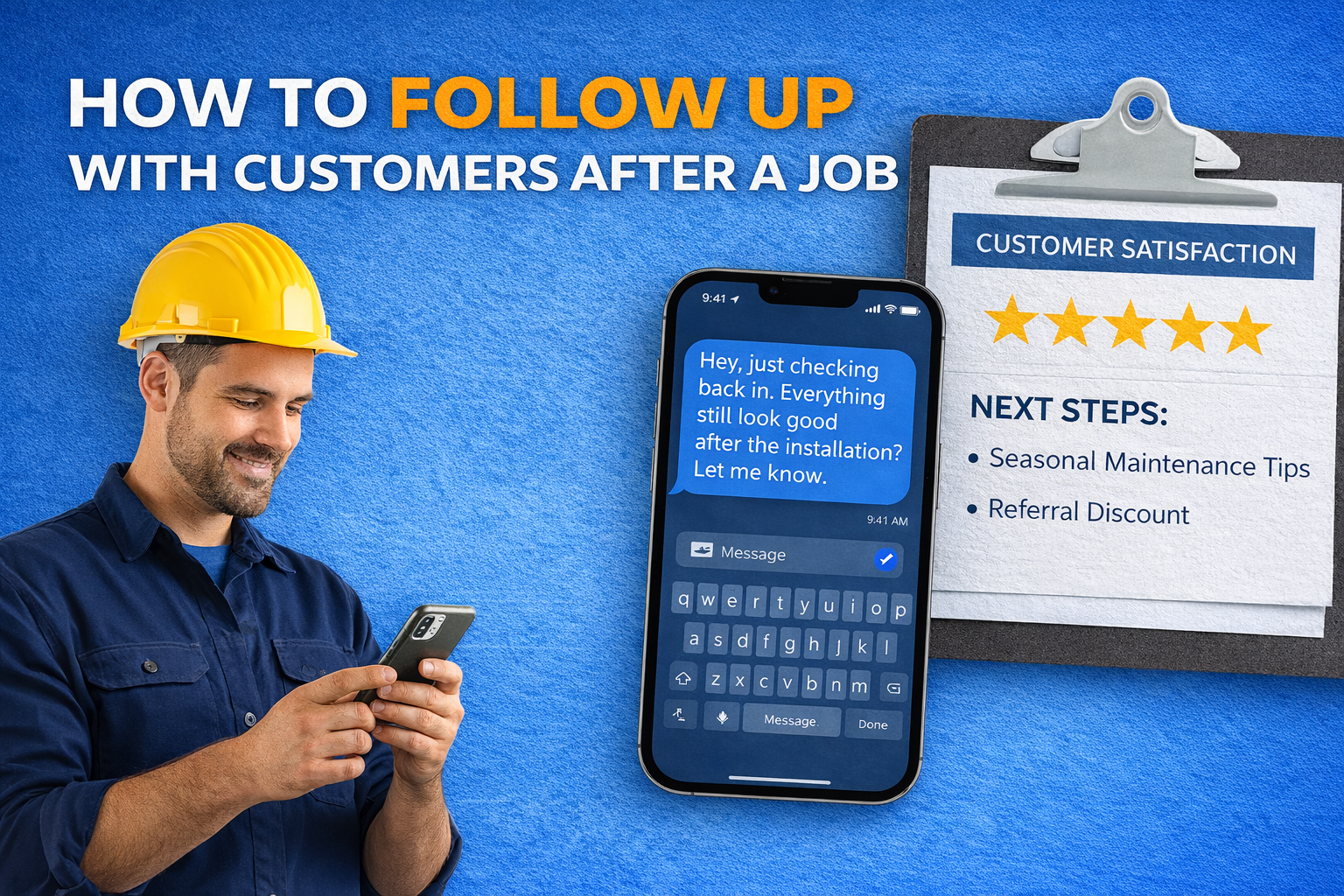
You finished the job, cleaned up, collected payment, and drove to the next one. That is the last most contractors ever think about a customer. No follow-up text, no check-in call, no seasonal reminder. Nothing.
Six months later, that same homeowner has a leaky faucet or a tripped breaker. They pull out their phone, scroll through their contacts, and your name is not there. So they Google "plumber near me" and pick whoever shows up first.
You just lost a repeat job to a stranger. Not because you did bad work. Because you disappeared.
This article gives you a complete, copy-paste follow-up system that turns one-time customers into people who call you for everything and refer you to everyone they know.
Why Most Contractors Never Follow Up (And Why It Costs Them)
Let us be honest about why follow-up does not happen. It is not laziness. It is the nature of the work. When you finish one job, you are already thinking about the next one. You are loading tools, driving across town, returning calls from new leads. Following up with someone who already paid you feels like a luxury you do not have time for.
But here is the math that changes the equation.
The Real Cost
Acquiring a new customer costs five to seven times more than keeping an existing one. If you spend $150 in marketing to win a new job, that is $150 you never have to spend again on every repeat call from someone you have already worked for. Multiply that across a year of jobs and the numbers are staggering.
Contractors who follow up consistently report 30 to 50 percent of their annual revenue coming from repeat customers and referrals. That is not a marketing theory. That is how the most profitable one- and two-person trade businesses actually operate.
The problem is not that follow-up does not work. The problem is that most follow-up advice is designed for salespeople in offices, not tradespeople in trucks. You need a system that takes less than two minutes per customer and runs mostly on autopilot.
The 3-Touch Follow-Up System
Forget complicated CRM software and email drip campaigns. Here is the simplest follow-up system that actually works for contractors. It has three touchpoints in the first month, and then shifts to seasonal mode.
Touch 1: The Same-Day Text (Within 2 Hours)
This is the most important message you will ever send a customer. Right after you finish a job, while your work is still fresh in their mind, send a short text. Not an invoice follow-up. Not a review request. Just a human check-in.
Hey [Name], thanks again for having me out today. Just wanted to make sure everything looks good with the [specific work]. If anything comes up, you have got my number. — [Your Name]
That is it. Thirty seconds to type. And it does three powerful things at once: it confirms they have your contact info, it shows you care about quality, and it opens the door for them to reply (which most people will).
When they reply with something like "Looks great, thanks!" you now have an active text thread. Their phone has your name saved in their messages. That alone makes you ten times easier to find six months from now than a paper business card stuck in a junk drawer.
Touch 2: The One-Week Check-In + Review Ask
One week after the job, send your second message. This is where you earn Google reviews without feeling awkward about it.
Hi [Name], just checking in on the [work you did] — everything still working well? If you are happy with how it turned out, a quick Google review would really help my business. Here is the link: [your review link]. Either way, thanks again for trusting me with the job.
The timing matters. At one week, the customer has had time to live with your work but it is still recent enough that they remember the details. This is the highest-conversion window for review requests.
Pro Tip
If you use a digital business card, your review link can be built right into your card. When customers save your contact to their phone, your Google review link is always one tap away. No need to text it separately every time.
Touch 3: The One-Month Value Drop
Thirty days after the job, send one more message. But this one is different. Instead of checking in on your work, offer something useful.
Hey [Name], quick heads-up — with [season] coming, now is a good time to [relevant maintenance tip]. Just figured I would mention it since I was already out at your place. Let me know if you ever need anything.
This message positions you as the expert who is looking out for them, not a contractor fishing for work. And it plants the seed for the next job naturally.
The contractors who earn the most referrals are the ones customers feel a personal connection with. Follow-up is not about selling. It is about proving you care about the work after you have already been paid. That is what people remember, and that is what they tell their neighbors about.
After the First Month: Seasonal Touchpoints
Once you complete the three-touch sequence, shift into seasonal mode. Two to four times per year, reach out to your past customers with a brief, useful message. Here are examples for each season.
- Spring: "Hey [Name], spring is a great time to check [relevant system] before the heavy-use months. Let me know if you want me to take a look."
- Summer: "Hi [Name], just a reminder that [summer-relevant maintenance tip]. Happy to help if you need anything."
- Fall: "Hey [Name], with winter coming, it is worth checking [relevant system]. I have openings this month if you want to get ahead of it."
- Winter: "Hi [Name], hope the holidays are treating you well. If anything comes up with [relevant system] this winter, I am just a text away."
Each of these messages takes thirty seconds to customize and send. Four messages a year. Two minutes of total effort per customer. That is the entire system.
Copy-Paste Templates You Can Use Today
Here are ready-to-use templates for the most common follow-up situations contractors face. Copy them into your phone notes and customize the brackets.
After a Standard Residential Job
Hey [Name], [Your Name] here from [Business]. Just wanted to make sure the [work] is holding up well. If you ever need anything or know someone who does, I am always just a text away. Have a great [day of week].
After an Emergency or Urgent Call
Hi [Name], glad we could get that [issue] taken care of quickly for you. Just checking — is everything still running smoothly? Save my number so you have it handy if anything else comes up. No more late-night Googling.
After a Large or Multi-Day Project
Hey [Name], thanks for trusting me with the [project]. It was a big one and I am really happy with how it turned out. I will check back in a couple weeks to make sure everything is perfect. In the meantime, do not hesitate to reach out.
The Referral Ask (Send After a Positive Response)
Really glad to hear that, [Name]. If you ever run into a friend or neighbor who needs [trade] work, I would really appreciate you passing my info along. Referrals are the biggest compliment I can get. Thanks again.
Why Your Contact Info Is the Bottleneck
Here is a pattern every contractor recognizes. A past customer wants to hire you again but cannot find your number. They dig through old texts, check their email, look in a kitchen drawer for a business card. If they find you, great. If they do not, they search Google and hire whoever shows up.
Follow-up solves half of this problem. It keeps you active in their text messages and fresh in their memory. But there is a second half most contractors miss: making your contact info permanently easy to find.
When a customer saves your contact to their phone, you are no longer competing with Google. You are in their contacts list permanently, right next to their dentist and their favorite restaurant. That is the real goal of follow-up. Not just to say hello, but to get saved.
This is where a digital business card changes the game. Instead of hoping they saved your number from a text thread, you give them a card they tap to save — your name, number, email, services, and even a quote request form, all saved directly to their phone contacts in one tap.
Create My Card — Live in 5 Minutes
A digital business card built for the trades. Customers save your info to their phone, request quotes, and share you with friends. No website needed.
The Follow-Up Mistake That Kills Referrals
The biggest mistake contractors make with follow-up is treating every message like a sales pitch. "Just checking in — do you need any work done?" That is not follow-up. That is cold calling someone who already hired you.
Effective follow-up is the opposite. It leads with value, asks nothing in return, and makes the customer feel looked after. When you do this consistently, the referrals happen on their own. People recommend contractors who made them feel taken care of, not contractors who asked for referrals.
Here is the hierarchy of follow-up messages, ranked from most effective to least effective.
- 1Quality check — "Is everything working well?" (Highest trust signal. Shows you stand behind your work.)
- 2Useful tip — "With winter coming, you might want to check your pipe insulation." (Positions you as the expert.)
- 3Seasonal reminder — "I have openings this month if you need anything before the holidays." (Subtle availability signal.)
- 4Review request — "A Google review would really help my business." (Best paired with a quality check.)
- 5Direct referral ask — "If you know anyone who needs work done, I would appreciate a referral." (Only after they have expressed satisfaction.)
Notice that the most effective messages ask for nothing. They give. The asking comes later, naturally, after you have deposited goodwill.
How to Manage Follow-Ups Without a CRM
You do not need expensive software to run this system. Here are three ways to manage follow-ups depending on your volume.
Low Volume (Under 10 Jobs Per Month)
Use your phone's built-in reminders. After each job, set three reminders: same day, one week, one month. When the reminder fires, open your texts, customize a template, and send. Total setup time: 30 seconds per job.
Medium Volume (10 to 30 Jobs Per Month)
Use a simple spreadsheet or notes app. Track customer name, job date, what you did, and which touchpoints you have completed. Spend five minutes every Friday morning sending your weekly batch of follow-ups.
Higher Volume (30+ Jobs Per Month)
At this volume, a basic CRM or scheduling tool starts making sense. But even here, the principle stays the same: three touches in the first month, then seasonal. The only thing that changes is how you track it.
Keep It Simple
The best follow-up system is the one you actually use. A complicated system you ignore is worse than a simple one you stick with. Start with phone reminders. If you outgrow them, upgrade. Do not over-engineer this.
The Compound Effect of Consistent Follow-Up
Here is what happens when you follow up consistently for a full year. Assume you complete 15 jobs per month and follow up with every customer.
After 12 months, you have 180 past customers who know your name, have your number, and have received multiple helpful messages from you. Even if only 20 percent of them hire you again or refer someone, that is 36 warm leads per year that cost you zero marketing dollars.
At an average job value of $500, that is $18,000 in revenue from follow-up alone. And those numbers compound. In year two, you have 360 past customers in your network. In year three, 540. Every year, the marketing cost per job goes down because a larger share of your work comes from people who already trust you.
This is how the most successful independent contractors build businesses that grow without proportionally increasing their ad spend. They are not marketing geniuses. They just follow up.
Start Today With One Text
You do not need to build the entire system before you start. Just do this: think of the last customer you completed a job for. Open your texts. Send them a 30-second check-in message using one of the templates above.
That is your follow-up system. One text. Then do it again tomorrow. And the day after that. Within a month, you will have a habit that most of your competitors will never build.
And if you want to make every follow-up more powerful, give customers something to save. A digital business card that puts your name, number, services, and quote request form permanently in their phone means your follow-up does not just remind them you exist — it makes sure they can always find you.