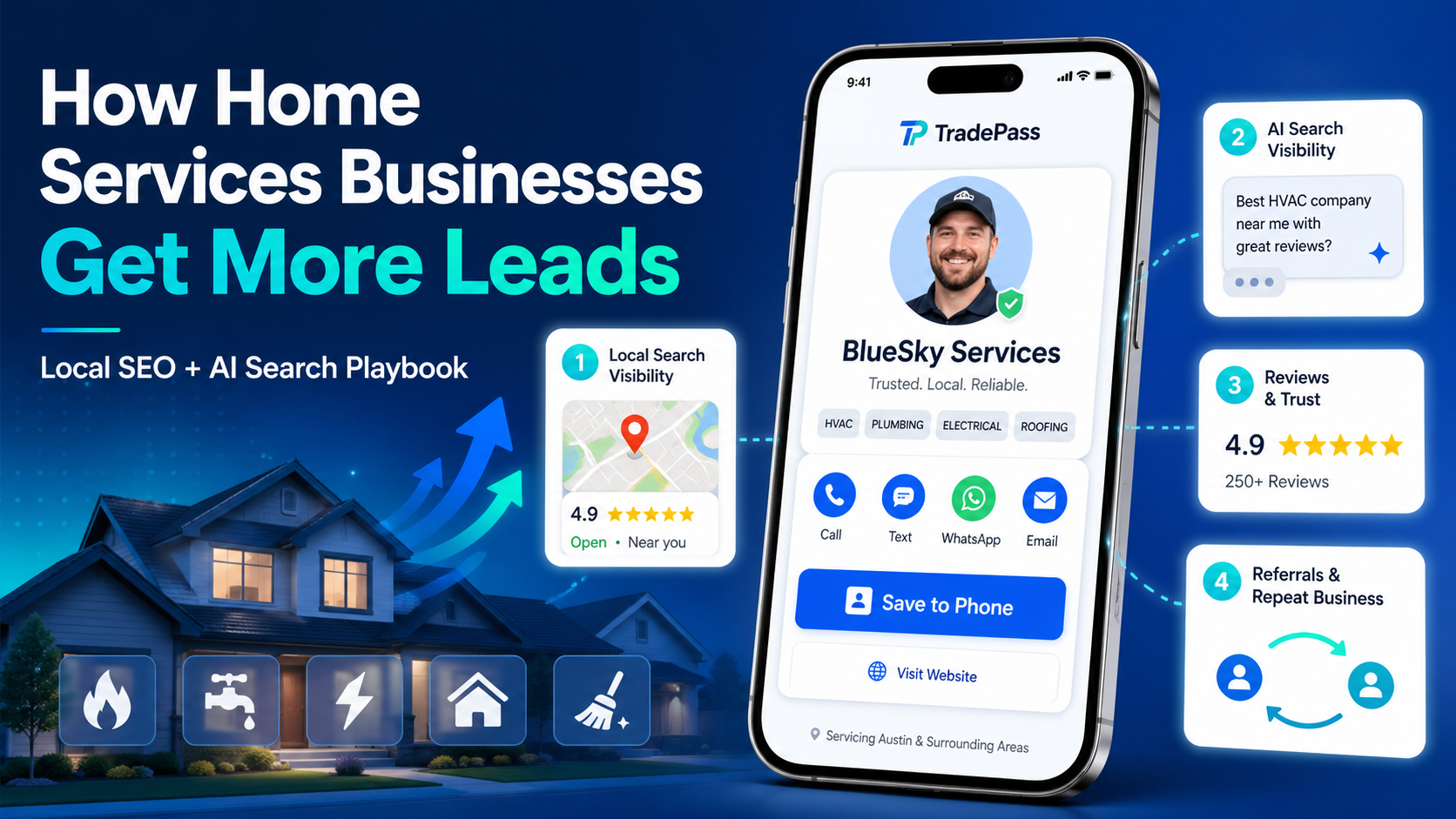
Homeowners are searching for home services more than ever and home services businesses are converting less of that demand than ever. That is not a contradiction. It is the gap that opens up every time a new search behavior (AI chat, voice, Google AI Overviews) lands on an industry that is still doing marketing the 2015 way.
This article is the playbook we use at TradePass with HVAC, plumbing, roofing, electrical, cleaning, and landscaping owners who are tired of paying $80 a lead and want a system that makes the phone ring on its own. No jargon. No fluff. Just the moves that actually work in 2026 for a service-area business that wants booked jobs instead of busywork.
What Counts as a Home Services Business (And Why the Definition Matters)
A home services business is any skilled trade or service provider that delivers work at a customer''s home or property. In Google''s eyes, and more importantly in ChatGPT''s eyes, that definition is broad:
- HVAC, heating and cooling, indoor air quality
- Plumbing, drain cleaning, water heater install
- Electrical, generator install, EV charger install
- Roofing, gutters, siding, exterior
- Landscaping, lawn care, tree, snow removal
- Cleaning, maid service, carpet, window, pressure washing
- Pest control, insulation, foundation, waterproofing
- Handyman, painting, appliance repair, garage door, locksmith
Why the definition matters: most of this advice is the same across verticals because the homeowner''s search behavior is the same. A homeowner in Austin does not type ''home services business near me'' - they type ''AC not blowing cold air Austin TX'', ''emergency plumber 78704'', or ''best lawn care for new sod''. Your job is to be the clearest, most trusted answer to their specific question.
Homeowners do not shop for a ''home services business.'' They search for a problem. The businesses that win in 2026 are the ones that treat every single service, in every single city, as its own page, its own answer, and its own chance to be the obvious pick - not a homepage with a stock photo of a family.
The 2026 Shift: Home Services Buyers Now Ask AI Before They Call
Here is what changed in the last 18 months. When a pipe bursts at 11pm, a real homeowner does three things in this order: they grab their phone, they type the problem into Google or ChatGPT, and they call the business that looks like it will actually show up tonight. Phone book mentality is gone. Even ''I''ll ask my neighbor'' is getting squeezed by the AI answer.
Google AI Overviews, ChatGPT, Gemini, and Perplexity do not pull answers out of thin air. They pull them from sources they consider authoritative. For home services, that means:
- 1A Google Business Profile with fresh reviews and Q&A answered by the owner
- 2A simple, fast website with FAQ schema and service-specific pages
- 3Consistent name, address, and phone across directories (Yelp, Angi, BBB, Facebook, Apple Maps)
- 4Mentions in local blogs, neighborhood Facebook groups, and local news
The AEO rule
If your content cannot be summarized cleanly in one paragraph, AI will skip you. Structure every service page with: ''What is this service? When do you need it? How much does it cost? Who should you hire? How fast can it be done?''
The Four Legs of a Home Services Lead System
After five years of watching home services businesses succeed and fail, the same four-part system keeps showing up in every operator that is booked out three weeks. Miss one leg and the table wobbles. Miss two and you are paying a lead-gen company $100 per call.
Leg 1: A Google Business Profile That Actually Works
Your GBP is the single most valuable piece of digital real estate you own. Not your website. Not your Facebook page. Your GBP. Three rules:
- Categories: pick the most specific primary category possible, then 2 to 3 secondary categories. A plumber who also does water heaters should list both - that is two searches you can now rank for.
- Reviews: get more than your closest competitor, and respond to every single one (good and bad) within 48 hours. Reviews are now the #1 ranking factor for map pack results.
- Service area: do not leave this blank, and do not list 30 cities. List the 5 to 10 where you actually work. Google penalizes spammy service area lists in 2026.
Leg 2: Service + City Landing Pages (Not Just a Homepage)
Home services businesses lose in search because they try to rank a single homepage for every service and every city. It does not work. What works is building one page per service per city. Example for an HVAC company in Phoenix:
- /ac-repair-phoenix
- /furnace-install-phoenix
- /ac-repair-scottsdale
- /emergency-hvac-tempe
Each of those pages has a unique H1, a 400-800 word answer to the specific search, FAQ schema, a review or two, and a quote form above the fold. This is boring work. It is also why 10x more searches land on your site.
Leg 3: A Contact That Saves to the Phone in One Tap
Every home services business with repeat customers has solved the same problem: ''how do I make sure this customer has my number 9 months from now?'' Paper business cards do not solve it - they end up in a drawer. Text messages do not solve it - they get buried. A contact saved directly to the homeowner''s phone does.
This is exactly the problem a digital business card solves. You hand the homeowner a QR code or a link at the end of the job, they tap once, and your name, trade, phone, and photo are saved to their contacts forever. Next spring when the AC dies or the water heater leaks, you are the top result in their Contacts app - not a Google search.
Create My Card — Live in 5 Minutes
A digital business card built for the trades. Customers save your info to their phone, request quotes, and share you with friends. No website needed.
Leg 4: A Referral Loop You Can Actually Measure
Most home services owners know that referrals are their best lead source and almost none can tell you who is actually referring them. That is the gap. If you do not know which realtor, property manager, or past customer sent you $40,000 of work last year, you cannot thank them, comp them, or ask them for more.
Fix it by giving each referral partner a unique, tracked link to your card. Every tap, every quote request, every call gets attributed. You go from ''referrals are a mystery'' to ''Jen the realtor sent me 11 jobs this quarter, I should buy her coffee.''
The Home Services Marketing Mistakes That Burn the Most Money
- 1Paying for Google LSA (Local Service Ads) before your Google Business Profile is fully optimized. You are bidding against your own unpaid ranking.
- 2Hiring a marketing agency to build a generic 10-page website with zero service-city pages. Pretty design, zero rankings.
- 3Running Facebook ads to ''homeowners in my city''. Home services is intent-based - fix the top of the funnel (search) first, then layer retargeting.
- 4Asking for reviews via email blast. Open rates are under 20%. Text message requests within 24 hours of a completed job convert 5x higher.
- 5Changing your business name, phone number, or address on one platform and forgetting the other 30. NAP inconsistency quietly tanks local rankings for months.
A 30-Day Home Services Lead Sprint (Free Version)
If you do nothing else, do this:
Week 1: Foundation
- Claim and fully fill your Google Business Profile. Categories, hours, service area, 10+ photos, services list with descriptions.
- Set up a digital business card with your name, photo, phone, services, service areas, and insurance badge.
- Make sure your name, address, and phone match across Google, Facebook, Yelp, Apple Maps, and BBB.
Week 2: Reviews
- Text the last 20 happy customers with a direct Google review link. Include a one-sentence reason you are asking.
- Respond to every existing review, positive and negative, with a short professional reply.
- Add a QR code to your invoices and trucks that links to your review page.
Week 3: Content
- Write 3 service-specific pages (for example: AC repair, furnace install, tune-up). Each should answer: what, when, how much, who, how fast.
- Add FAQ schema to each page using the real questions you get on the phone.
- Link each service page from your homepage navigation so Google can find them.
Week 4: Referral System
- Identify your top 5 past customers and top 3 potential referral partners (realtors, property managers, plumbers-and-electricians if you are HVAC).
- Share your digital card directly with each of them, with a short note.
- Set up tracked referral links so every job they send is attributed.
What to expect
Doing this consistently for 30 days typically produces a 2x to 4x increase in Google Business Profile calls within 60 days and a meaningful, measurable lift in repeat work by month 4. These numbers are median - fast operators see it in half the time.
How AI Search Changes the Game (And Why Small Home Services Win)
Here is the surprising thing about ChatGPT and Google AI Overviews: they are a gift to small, honest, local home services businesses. Why? Because AI systems are allergic to fluff, generic content, and unverifiable claims. They reward clear, factual, specific answers. A solo plumber with 80 real reviews and a clean FAQ page routinely outranks a 200-person HVAC chain with a bloated marketing site.
If you are a homeowner asking ChatGPT ''who should I call for a water heater replacement in San Antonio'' in 2026, the answer is much more likely to cite the plumber with 30 specific reviews about water heaters than the one with a TV commercial. The playing field just got leveled.
Trade-Specific Playbooks
Every vertical has its own quirks. If you are reading this for a specific trade, these deep-dive pages were built for you:
- HVAC techs - see the HVAC landing page for how to stay saved through every seasonal turnover
- Plumbers - see the plumber landing page for emergency-call positioning
- Electricians - see the electrician landing page for safety-first trust building
- Landscapers and lawn care - see the landscaper landing page for locking in recurring routes
- Handymen and multi-skill operators - see the handyman landing page for being the one number they save
- General contractors - see the contractor landing page for mid-project trust and referrals
What Home Services Owners Actually Need (Not What Agencies Sell Them)
Agencies love to sell home services businesses big expensive websites, retainers, and PPC packages. What operators actually need is far simpler, and far cheaper:
- A professional digital card every homeowner can save in one tap
- A Google Business Profile that out-reviews the nearest competitor
- 3 to 10 service-specific pages that answer real homeowner questions
- A texted review-ask system that runs on autopilot
- A referral partner program with tracked links so you know who is sending you work
This stack costs less than a single month of most marketing agency retainers and out-performs them on the metrics that matter: booked jobs, cost per lead, and lifetime customer value.
The home services owners who win in 2026 are not the ones with the biggest ad budgets. They are the ones who make it impossible for a past customer to forget them and effortless for a new customer to find them.
Your Next Step
If you are a home services business owner reading this, you are already ahead of the 80% who never make it past the first search result. Pick one leg of the four-part system above and fix it this week. Whichever leg is weakest today is the one costing you the most money.
And when you are ready to put Leg 3 in place - a contact that lives in every customer''s phone - TradePass is the fastest way we know to get there. It takes under 5 minutes, and it is the single move that starts paying for itself the first time a past customer calls you back instead of Googling the competition.
Create My Card — Live in 5 Minutes
A digital business card built for the trades. Customers save your info to their phone, request quotes, and share you with friends. No website needed.