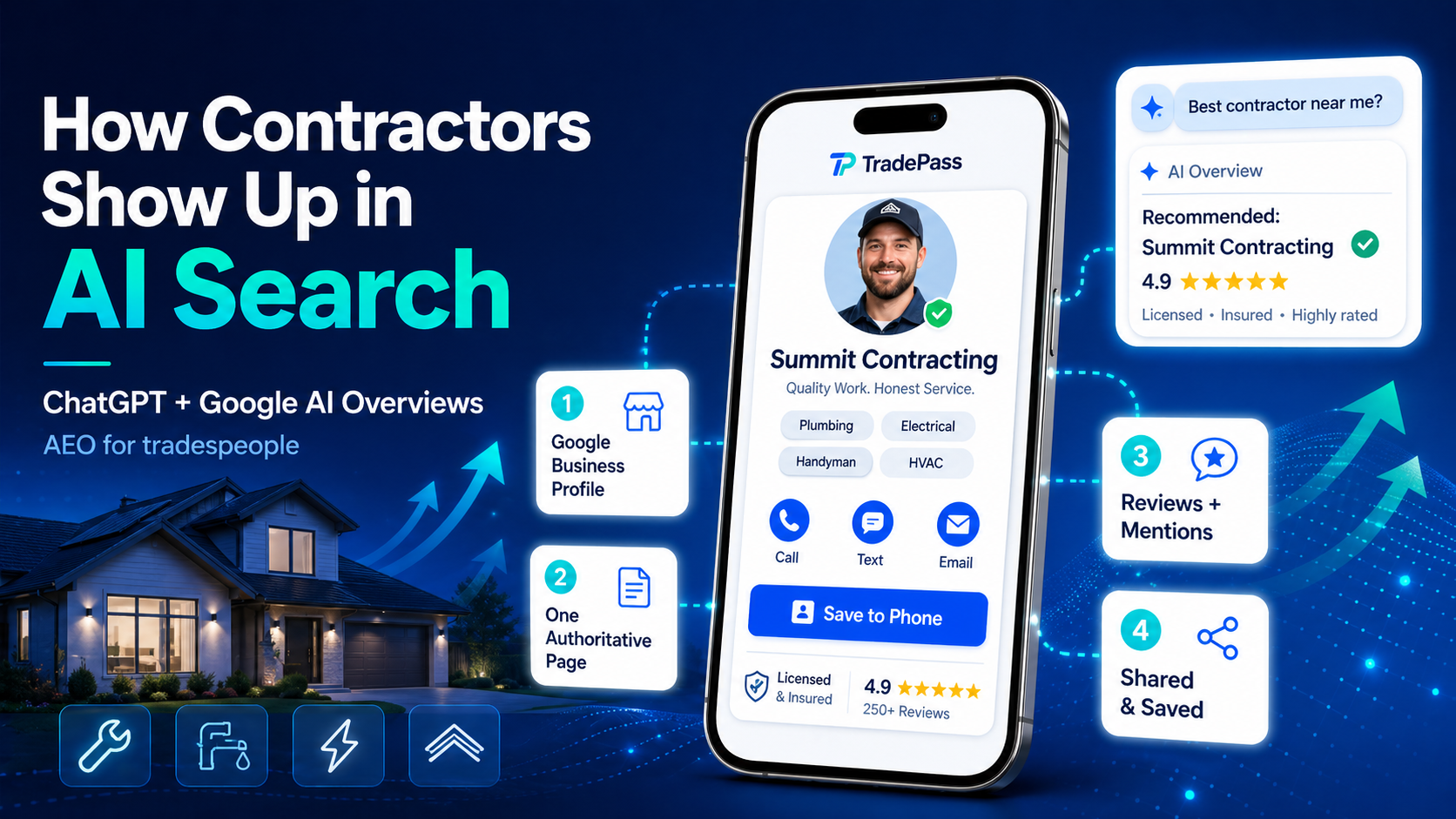
Last month a homeowner in Round Rock typed this into ChatGPT: 'My water heater is leaking into the garage. Who should I call in Austin?' ChatGPT returned three specific plumbers by name, with their phone numbers and a one-sentence reason for each. The homeowner called the first one on the list. He had never heard of them. He did not search Google. He did not ask a neighbor. He just called the name ChatGPT gave him.
That homeowner is not unusual anymore. He is the leading edge of how a generation of customers is going to start hiring tradespeople. And the plumber he called did not get lucky. He had built a business that AI systems could read, verify, and trust enough to cite by name.
This guide is the plain-English version of exactly how that happened and how you do it for your own business. No jargon. No 'leverage synergies.' No ten-thousand-word essays about the history of search. Just the specific, practical steps a contractor, plumber, electrician, handyman, or HVAC tech can take this week to become the name ChatGPT, Google AI Overviews, Perplexity, and Gemini give back when a homeowner asks for help.
The Thing That Actually Changed
For twenty years, the way a homeowner found a contractor online was simple. They typed something into Google. Google returned ten blue links. The homeowner clicked one, maybe two, read a bit, and called. If you ranked in that top ten, you got business. If you did not, you did not.
That model is breaking. Not gone. Breaking. In 2024 Google rolled out AI Overviews -- those generated summaries that sit above the blue links. In 2025 and 2026, homeowners started talking to ChatGPT the way they used to talk to Google. Perplexity, Gemini, and Claude all let people ask questions in plain language and get plain-language answers back. The answer is no longer ten links. It is one paragraph that names specific businesses.
For a contractor, this is not a technical problem. It is a positioning problem. Ten blue links meant ten chances to get a click. One AI answer means one name gets mentioned and the others do not exist. The winners in this new layer of search are not the biggest companies. They are the businesses with the cleanest information and the clearest signals of legitimacy.
What AEO Actually Means for a Contractor
Answer Engine Optimization -- AEO -- is the practice of making your business easy for an AI to name. You have probably heard it called generative engine optimization, GEO, or LLM SEO. Same thing. Different acronyms. The core idea is that you are no longer optimizing for a ranking. You are optimizing for a citation.
Here is the difference. Traditional SEO asks: 'How do I get to position 3 for plumber Austin?' AEO asks: 'When a homeowner asks an AI 'who should I call for a water heater leak in North Austin,' what would have to be true for the AI to say my name?' That is a completely different question and it has a completely different answer.
"The most underrated shift happening in local search is that AI systems do not want to hedge. They want to give a clean, confident answer. If your business information is consistent, your reviews are real, and there is a single authoritative page they can point to, you become the path of least resistance. If any of those pieces are missing or contradictory, the AI hedges -- and hedging means recommending someone else." -- Tim Brown, founder of Hook Agency, author of 'How to Become a Hometown Hero,' and one of the most-cited voices in home-services marketing
Read that quote twice. It is the whole game. AI systems do not want to hedge. They want one clear answer. Your job is to be the clearest answer in your category, in your city, for the specific problem the homeowner is describing.
How AI Systems Actually Decide Who to Recommend
Every major AI search tool -- ChatGPT with browsing, Google AI Overviews, Perplexity, Gemini, Claude with web access -- works roughly the same way when answering a local question. They pull from three buckets of information.
The first bucket is structured business data. That means your Google Business Profile, your Bing Places listing, Apple Business Connect, and major directories like Yelp, BBB, Angi, HomeAdvisor, Thumbtack. These sources have predictable fields -- name, phone, address, category, hours, reviews -- and AI systems trust them because the data is structured.
The second bucket is your own web presence. Your website if you have one. Your digital business card page. Your social profiles. Anything you control that has your business information in a form a crawler can read.
The third bucket is third-party mentions. Articles about you. Review quotes. Local news coverage. Community board mentions. Any place on the public web where your business is named in context, especially by sources the AI considers trustworthy.
The AI cross-references all three. If the information matches across the buckets, you become a high-confidence recommendation. If it contradicts -- different phone numbers, different spellings of your company name, missing categories, absent reviews -- the AI either recommends someone else or hedges with a generic answer like 'check your local directory.' That hedge is where most contractors live right now. The goal of AEO is to get out of it.
The Seven Things Every Contractor Needs to Do
These are ordered by impact. If you only have an hour this week, do the first two. If you only have a Saturday, do all seven. None of this requires paying an agency.
1. Lock Down Your Core Five
Write down these five pieces of information exactly the way you want them to appear everywhere on the internet: your legal business name, your phone number (in one format -- pick '(512) 555-0198' or '512-555-0198' and stick with it), your service area or address, your primary trade category ('Licensed Plumber,' not 'Professional Services'), and your license number if applicable.
These five values are your ground truth. Every listing, every profile, every page you control should match these exactly. AI systems use consistency as a trust signal. Inconsistency is the single most common reason a contractor fails to get cited.
2. Fix Your Google Business Profile Like Your Rent Depends On It
Your Google Business Profile is the single most important asset in AI search for contractors. It is the primary source Google AI Overviews pulls from, and ChatGPT, Gemini, and Perplexity all reference it heavily. If your profile is incomplete, incorrect, or missing, you are invisible to AI search, period.
Claim the profile. Verify it. Fill in every field -- not most, every. Primary category. Secondary categories for every service you perform. Service area with specific city and neighborhood names. Hours of operation. Phone. Website or digital card link. Add photos, at least a dozen, of real jobs you have done. Write a description in plain language that includes your trade, your service area, and what you actually do.
Then get reviews. Real ones, from real customers. Five-star reviews with specific detail ('Mike fixed our main water line in Round Rock the same day we called') are fuel for AEO because they give the AI exact phrases to match against specific homeowner queries. Aim for one or two fresh reviews a month, permanently.
3. Create One Authoritative Page for Your Business
AI systems need a page they can point to as the canonical source for your business. This is where you live on the public web. It does not need to be a full website with fifteen service pages. It needs to be one page, at one URL, with every detail about your business in a format that is easy to parse.
The page must include: your business name as a clear heading, your primary trade, your full service area (every city and neighborhood you cover), your phone number, your license and insurance status, your years of experience, a photo of you or your work, any relevant certifications, and a clear way to contact you. If it loads on a phone in under three seconds and the information is visible without scrolling forever, you have built something AI can read.
This is where a lot of contractors get stuck. Either they do not have a website and cannot afford one, or they have a cluttered five-year-old WordPress site where the information is scattered across ten pages. This is exactly the gap TradePass was built to fill. A TradePass card gives you a single clean URL with structured contact information, clear service areas, trade-specific labels, license and insurance badges, a review rating with stars, and an unambiguous phone-and-email contact block. It is designed from the ground up to be the page an AI cites when asked about you. You get the AEO benefit of a custom-built landing page without paying a developer or learning to code.
If you do not want to use TradePass, that is fine. The principles are the same. One page. Clean information. Mobile-friendly. Fast. Linked to from your Google Business Profile. That is the minimum.
4. Scrub Your Directory Listings
This is the job everyone hates and nobody skips. Search your business name on Google. Look at every directory listing that comes up -- Yelp, BBB, Angi, HomeAdvisor, Thumbtack, Manta, SuperPages, Yellow Pages, every old vertical directory you forgot you signed up for. On each one, verify that your core five (name, phone, service area, trade, license) matches exactly. Fix or delete anything that is outdated.
A directory listing with your old phone number is worse than no listing. It splits the AI's signal and makes it hedge. Give yourself a Saturday morning, a coffee, and go through every listing until the information is consistent everywhere.
5. Write Content That Answers the Questions Homeowners Ask an AI
When a homeowner asks ChatGPT 'how much does it cost to replace a water heater in Texas,' the AI pulls from pages that actually answer that question. If you have a short article on your site titled 'Water Heater Replacement Cost in Austin (2026 Homeowner Guide)' and it contains a real, honest answer with specific price ranges, the AI will cite it. And when it does, it often names you in the same response.
You do not need a content marketing strategy. You need four or five pages that answer the real questions the homeowners in your service area ask. Cost questions. 'How do I know if I need to replace X.' 'What licenses do I need to check before hiring a contractor.' Local-specific questions ('hard water in Austin,' 'slab foundation plumbing in Central Texas'). Write in your voice. Use specifics. Mention your service area. If you do not have a website to post them on, consider whether an expanded card platform with content pages fits your needs, or partner with a local blog that already ranks.
6. Get Mentioned By Name Somewhere Credible
AI systems weight third-party mentions heavily because they cannot be manipulated the way your own pages can. Every time your business is named in an article, a Reddit thread, a Nextdoor recommendation, a local Facebook group, a BBB profile, or a local news piece, you add a signal that says 'this business exists and does the thing it claims to do.'
Practical ways to generate these mentions without paying for PR: ask a happy customer to recommend you by name in a local Facebook group next time someone asks. Reach out to your local realtor partners and ask for a written testimonial on their site. Sponsor a youth sports team and get your business named on the team page. Write a guest post for a local home improvement blog. These mentions are cheap, durable, and exactly what AI systems are looking for.
7. Make It Frictionless for Happy Customers to Share You
This one is the connective tissue between word of mouth and AI search and almost nobody talks about it. Here is the mechanic: a satisfied customer wants to refer you. If they cannot find your information in under ten seconds, the referral dies -- and the friend who needed the recommendation asks an AI instead. If your AEO is weak, that AI names someone else, and you just lost a warm lead to a competitor because of a logistics failure.
Make sharing you a one-tap action. A digital card link saved in a customer's phone contacts, forwardable by text, is the single highest-converting referral asset a tradesperson can own. It turns every satisfied customer into a permanent node in your referral network -- and it feeds the same AI systems you are trying to rank in, because every share creates another surface where your information lives.
This is the soft-sell part, and we are going to be direct about it. TradePass is built for this exact moment. One link. Saves to contacts in one tap. Forwardable by text. Structured for AI to read. The entire product exists because we believe AEO for tradespeople is not a content problem or an SEO problem -- it is a distribution problem. You need to be everywhere the homeowner might look, in a form that every system can understand. TradePass is the tool that handles that distribution in the background while you keep running the actual business.
What to Ignore
Plenty of people are going to sell you expensive AEO packages this year. Most of them are repackaged SEO retainers with a new label. Here is what you can safely ignore in 2026 unless you are running a multi-state operation with a real marketing budget.
- Schema markup consultants who want $2,000 to add JSON-LD to your site. Useful in some contexts, overkill for a solo contractor. A good Google Business Profile plus a clean card page accomplishes 80 percent of the same thing for free.
- AI chatbot widgets for your website. They do not help you get cited by ChatGPT. They are a different problem.
- Paid 'AI listings services' that promise to submit you to '500+ AI directories.' The directories that matter are public, free, and you already know the names.
- Anyone who tells you to flood your site with AI-generated content. AI systems have gotten good at detecting AI slop and are actively downranking it. Write less, write it yourself, make it specific to your city and your trade.
- Voice search optimization as its own discipline. Voice is just a delivery mechanism. The underlying ranking is the same AEO work described above.
A Realistic Timeline
Here is what actually happens if you do the work above, based on what we see from contractors using TradePass and tracking their AI visibility.
Week 1: Core five locked down. Google Business Profile audited. Card page live. You do not see results yet but the foundation is in place.
Weeks 2-4: Directory scrub complete. A handful of fresh reviews. AI systems start picking up the consistent signal. You start seeing your business mentioned in AI Overviews for your name searches, sometimes for your trade-plus-city searches.
Weeks 4-8: Content pages indexed. Third-party mentions accumulating. You begin showing up in ChatGPT and Perplexity responses for specific problem-plus-location queries in your service area. Some contractors report their first AI-sourced lead in this window.
Months 3-6: Compound effects kick in. Every new review, every new mention, every new content page is another signal. You become a default recommendation in your service area for your trade, alongside the four or five other businesses the AI trusts. At this stage, AI search stops feeling like a new channel and starts feeling like part of your existing word of mouth -- an extension of it, rather than a replacement.
The Honest Bottom Line
Most contractors are going to ignore this article. They are going to keep handing out paper business cards and hoping the phone rings. Some of them will be fine because their referral networks are strong enough to absorb the change. Most will quietly lose market share over the next two to three years without ever understanding why their lead flow is softening.
The contractors who win the next decade are going to be the ones who understood one simple thing early: the way homeowners find tradespeople is fragmenting. Google is still there. Word of mouth is still there. But ChatGPT, Gemini, Perplexity, and Google AI Overviews are now a real channel -- and the channel is young enough that a solo contractor in Austin or Kansas City or Sacramento can become the default recommendation in their category simply by having cleaner information than their competitors.
That is it. That is the whole thing. You do not need a PhD in machine learning. You need consistent information, one authoritative page, a real Google Business Profile, honest reviews, and a distribution tool that makes it easy for satisfied customers to share your contact. Every other AEO tactic worth doing is a variation on those five.
Do the core work. Keep doing the craft. Let the AI systems find you because you made yourself findable. The homeowner asking ChatGPT about a leaking water heater is going to keep asking. The only question is whether the answer includes your name.
Create My Card — Live in 5 Minutes
A digital business card built for the trades. Customers save your info to their phone, request quotes, and share you with friends. No website needed.