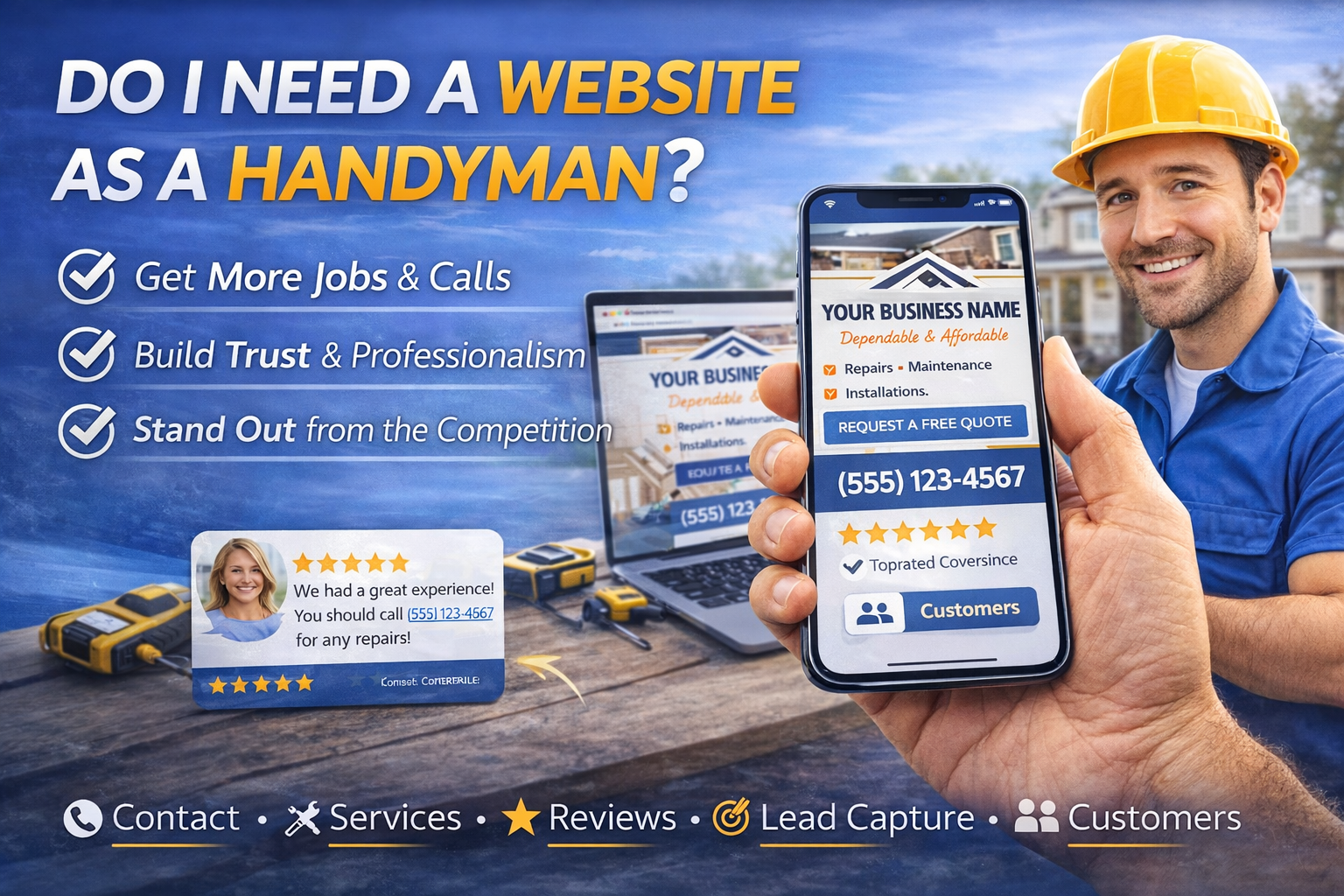
If you're a handyman, you've probably heard this advice: "You need a website." Maybe from a friend, a marketing company, or that guy at the hardware store who "does web design on the side."
Here's the thing... for many handymen and solo contractors, a traditional website can be a huge waste of money. But having zero online presence is a huge problem also. Let's break down what actually makes sense.
The Case Against a Traditional Website
Websites can be great when SEO, design, and functionality are dialed in. In practice however, here's what happens for most handymen who build one:
- You pay $500-$3,000 to get it built (or spend weeks doing it yourself)
- It sits on page 5 of Google because you're not doing SEO
- The "contact form" leads go to an email you never check
- You forget to update it, and it starts going outdated within a year
- Your actual customers find you through word of mouth, not Google searches as intended.
Most handymen don't need a full website to show up online. What they need is a way for past customers and referrals to find them easily — and a professional online page that can actually represent them when someone does search Google. A traditional website is one way to do that. It's just not the only way, and for most solo operators, it's not the smartest way.
When a Website Actually Makes Sense
To be fair, there are situations where a website is worth the investment:
- 1You run a multi-person operation and need to show off a portfolio of large projects
- 2You're spending money on Google Ads and need multiple landing pages for those ads
- 3You serve a specific niche (like kitchen remodels) and want to rank for those specific searches
- 4You have the budget to hire someone to actually maintain and optimize it
If none of those apply to you, a website is probably not where you should be spending your time or money.
What You Actually Need: An Online Presence That Works for You
Here's what every handyman and contractor actually needs, website or not:
- A way for customers to save your contact info permanently (not just an old business card)
- Your name, phone, services, and a professional photo in one place
- An easy way for past customers to share your info with friends and neighbors
- A way for potential customers to request a quote without having to call during business hours
- A mini-website/landing page that customers find when searching online.
Key insight
Your biggest competitor isn't the handyman down the street. It's Google. Every time a past customer can't find your number and searches "handyman near me" instead, you're competing against every handyman in town.
Create My Card — Live in 5 Minutes
A digital business card built for the trades. Customers save your info to their phone, request quotes, and share you with friends. No website needed.
The Smart Digital Business Card Alternative
A smart digital business card gives you everything a website does for customer retention, without the cost or hassle. With a service like TradePass, you get a professional page (mini-website/landing page) with your info, a save-to-contacts button, and a built-in quote request form.
You share it via text, email, or QR code after every job. The customer saves your info to their phone. Later when they need more work, they search their contacts — not Google. That's how you keep the work you've already earned.
The Smart Approach: Start Simple, Scale Later
If you're just getting started or running a one-person operation, here's the practical order of priority:
- 1Get a Smart digital business card set up (5 minutes, covers your online presence and customer retention)
- 2Claim your Google Business Profile (free, helps you show up in local searches)
- 3Build a basic website only if you're ready to invest in SEO or run ads to multiple landing pages
- 4Consider a full site when your business grows to the point where you need a portfolio and team page
Most handymen will get 80% of the benefit from steps 1 and 2 alone. Don't let someone convince you that you need a $2,000 website before you've maxed out the free and low-cost options.
Bottom Line
You don't need a website to run a successful handyman business. You need a way for customers to save your info, find you again, share your contact with others, and find you online. If you can do that with a smart digital business card and a Google Business Profile, you're ahead of 90% of handymen who are paying for websites nobody visits.