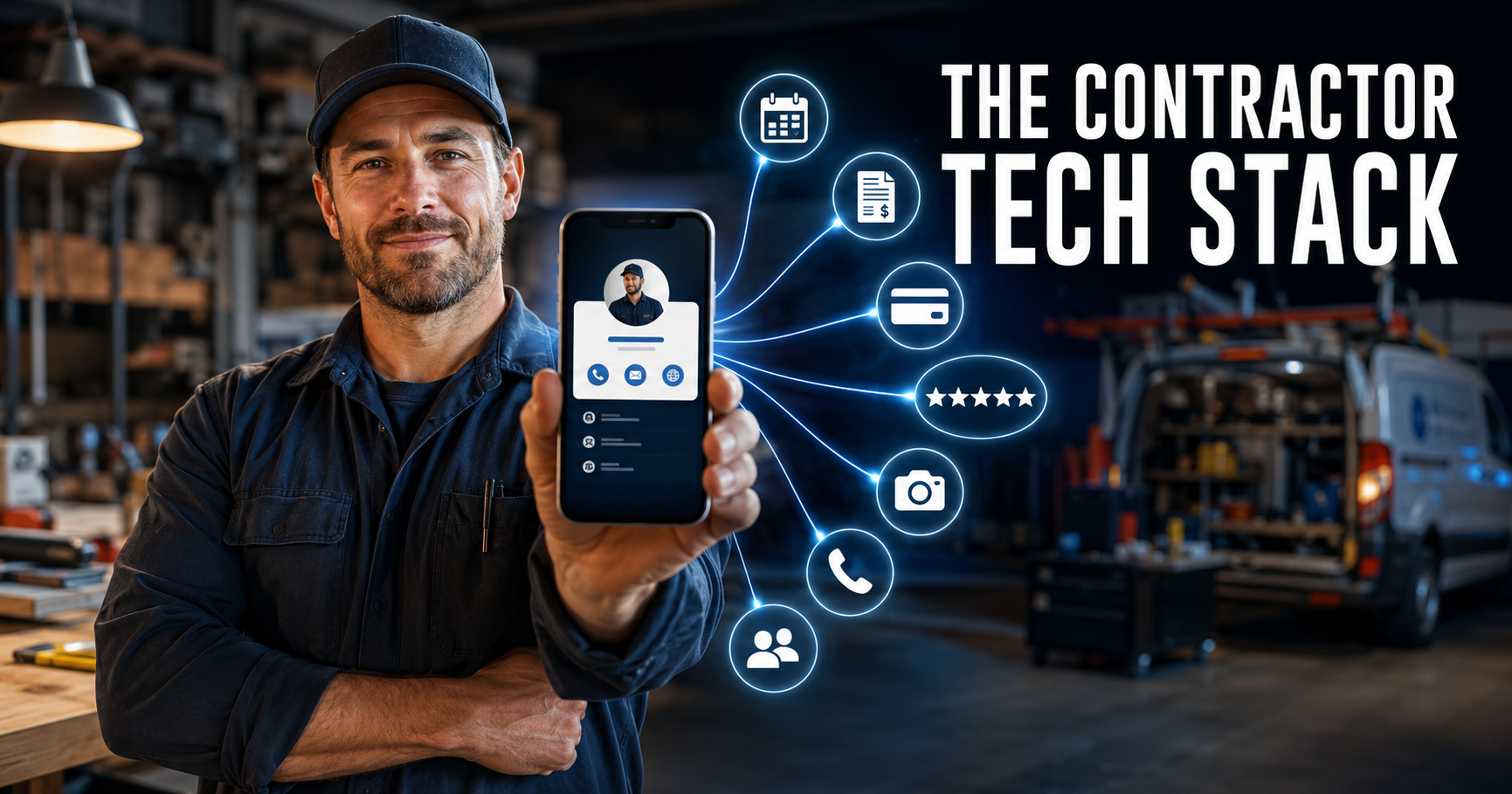
Picture this: you just finished a kitchen remodel. The homeowner is thrilled. She says she will recommend you to everyone. Three months later, her neighbor needs a bathroom done — and hires someone else. Not because you did bad work. Because your number was buried in a text thread from last spring, and she could not find it. A digital business card solves that problem. But paired with the right tools, it becomes the center of a system that turns every finished job into the next one.
This is not a list of every app that exists. It is a curated, fact-checked guide to the best apps and tools that actually matter for contractors, handymen, plumbers, electricians, HVAC techs, and landscapers running businesses with one to fifteen people. Every price listed here was verified against official sources in August 2026. If you are looking for contractor app recommendations you can trust, this is the one article that did the homework.
Why Your Digital Card Needs a Supporting Cast
A digital business card handles the first impression: your name, trade, reviews, photos, and a way to request a quote. But a first impression without follow-through is just a missed opportunity. The tools in this guide handle everything that happens after someone taps your card.
Research backs this up. According to Jobber's Q1 2025 Home Service Economic Report, digital payments now account for 47 percent of all home service transactions, up from 43 percent a year earlier. Homeowners increasingly expect the contractors they hire to operate digitally, from first contact through final payment.
The way homeowners find and choose service pros has changed dramatically — credibility is now built online, often before a single conversation takes place. By combining powerful digital marketing tools with actionable insights, we're giving small businesses the same strategic advantages as much larger companies.
The goal is not to adopt every tool on this list. It is to build a lean stack where each piece connects to the others, with your digital business card as the hub that ties the customer experience together. Think of these as contractor software recommendations organized by the job they do in your business, not a shopping list.
Job Management and CRM: Where Your Leads Go After the Card
When someone taps your NFC card or opens your link and submits a quote request, that lead needs to land somewhere organized. These platforms handle the full job lifecycle from quote to payment.
Jobber
Jobber is used by more than 400,000 home service professionals across 50-plus industries. It handles quoting, scheduling, invoicing, GPS tracking, and online booking in a single app designed specifically for field service businesses. It is especially popular with landscapers, cleaning companies, and general contractors.
The connection to your digital card is direct: a customer submits a quote request through your card, you create the estimate in Jobber, schedule the job, send the invoice, and collect payment. Jobber's online booking link can also be embedded directly on your card.
Pricing starts at approximately $39 per month for solo operators on the Core plan. The Connect plan runs around $119 per month for growing teams.
Housecall Pro
Housecall Pro serves over 200,000 professionals and is particularly strong among plumbers, electricians, and HVAC technicians. It offers dispatching, online booking, automated review requests, invoicing, and payment processing.
The referral angle here is powerful: Housecall Pro sends automated review requests after every job. Those reviews then display on your digital business card, which generates more leads, which become more reviews. It is a self-reinforcing cycle.
The Basic plan starts at $59 per month with an annual commitment, or $79 per month without one.
ServiceTitan
For shops with five or more technicians, ServiceTitan offers enterprise-grade dispatching, pricebook management, marketing attribution, and membership tracking. It is the industry heavyweight among mid-size HVAC, plumbing, and electrical companies. Each technician can carry their own digital business card that routes leads into ServiceTitan's booking system, and the platform's lead-source tracking can measure how card-generated leads convert compared to paid channels.
Pricing is custom and typically starts above $245 per month with an annual contract. This is overkill for true solo operators but standard for established shops.
Business Phone: The Number on Your Card Matters
The phone number displayed on your digital card should be a dedicated business line, not your personal cell. A business number keeps your personal life separate, looks more professional, and lets you track where calls are coming from.
OpenPhone (Now Quo)
OpenPhone, which rebranded to Quo in mid-2026, provides a business phone system with shared numbers, texting, lightweight CRM features, and call recording — all from your smartphone. You will still find it listed as OpenPhone in many app stores and directories, so search for either name. When a prospect taps the call button on your digital card, it rings through to the app where the call is logged automatically. Some users set up auto-text replies that send their digital card link to missed callers.
The Starter plan is $19 per user per month. The Business plan runs $33 per user per month and adds call transfers, analytics, and integrations.
Google Voice
Google Voice gives you a free virtual number that forwards to your personal phone. It is the simplest way to put a professional number on your digital card without any monthly cost. For contractors just getting started who want to separate work from personal calls, this is the obvious first step.
The personal version is free. Google Voice for Google Workspace starts at $10 per user per month with additional features like multi-level auto attendants and desk phone support.
Grasshopper
Grasshopper has been around since 2003 and is still a solid choice for contractors who want a professional phone system with multiple extensions and a polished auto-attendant greeting. Plans start at $14 per month on an annual commitment for a single number with one extension. The Business plan at $55 per month adds multiple numbers and extensions. Grasshopper is especially useful when multiple crew members each have their own digital card but all calls should route through one business number.
Reviews and Reputation: The Trust Layer on Your Card
Your digital card makes a strong first impression. Reviews make that impression stick. According to BrightLocal's 2025 Local Consumer Review Survey, 42 percent of consumers trust online reviews as much as personal recommendations. That number has shifted over the years, but the underlying behavior is clear: people read reviews before they call.
Google Business Profile
This is the single most important free tool any contractor can set up. Your Google review rating and review count should display prominently on your digital card, or link directly to your profile. After every job, the workflow is: finish the work, hand the customer your NFC card or send your link, then follow up with a Google review request.
More reviews improve your ranking in Google Maps and local search results while also making your digital card more compelling. This is a compounding return, and it costs nothing.
NiceJob
NiceJob automates the part most contractors forget: actually asking for the review. It sends SMS and email review requests after each completed job, driving customers to leave Google and Facebook reviews. Those reviews then show up as social proof on your digital card.
The Grow plan is $75 per month, and the Pro plan with AI-powered review replies and referral campaigns is $125 per month. NiceJob integrates natively with Jobber, which makes the two a natural pair.
Lead Platforms: Where Your Card Replaces the Per-Lead Fee
Paid lead platforms charge anywhere from $15 to $150 per lead depending on your trade and market. Your digital business card turns every customer from those platforms into a free referral source. The math matters: research from the Wharton School of Business found that referred customers spend 16 percent more than non-referred customers and have higher lifetime value. Structured referral programs close leads at 30 to 50 percent, compared to 8 to 15 percent for paid lead channels.
Thumbtack
Thumbtack matches homeowners with local pros on a pay-per-lead basis. Costs vary widely by trade and market but can reach $100 or more per lead in competitive areas. The strategy: win the Thumbtack job, do great work, hand them your digital card or NFC tap card at the end, and let them share you with neighbors for free. Your card turns an expensive paid lead into an ongoing referral source that owes you nothing per lead.
Nextdoor
Nextdoor is where neighbors recommend contractors to each other. When someone posts asking for a good plumber or electrician, a happy customer can drop your digital card link in the comments. Unlike typing out a phone number, your link shows your reviews, photos of work, and a quote request form all in one tap. This is word-of-mouth with proof attached, and it is free.
Google Local Services Ads
Google LSA places Google Guaranteed contractors at the top of search results on a pay-per-lead basis, typically $25 to $150 per lead. These are high-intent homeowners actively searching for help. After completing an LSA job, handing them your digital card ensures they can easily refer you, multiplying the return on that initial lead cost over time.
Angi (Formerly HomeAdvisor)
Angi connects homeowners with prescreened contractors through both lead generation and advertising. Lead costs range from roughly $15 to $150 depending on the service. The same principle applies: every Angi customer you impress and hand a card to becomes a potential source of free leads that bypass the per-lead fee entirely.
Payments and Invoicing: Getting Paid After the Card Does Its Job
The lead comes through your card, you do the work, and now you need to get paid. These tools handle the financial handoff.
Square
Square is the most widely used payment platform among small contractors for good reason: invoicing is free, the mobile app accepts tap-to-pay on your phone, and the interface is simple enough that you can hand it to an apprentice on day one. Processing fees are 2.6 percent plus 10 cents per in-person transaction and 2.9 percent plus 30 cents for online invoices.
A Square payment link or online invoice URL can even be added to your digital card for repeat customers who want to pay a deposit upfront.
QuickBooks
QuickBooks is the accounting standard for small businesses. Most accountants who work with contractors expect it. Simple Start runs around $30 per month, though introductory discounts of 50 to 75 percent are common for the first three to six months. It handles estimates, invoicing, expense tracking, and tax prep. When leads come through your digital card, QuickBooks manages the financial trail from estimate to final payment.
Wave
Wave is the free option. Invoicing and accounting cost nothing. You only pay processing fees when a customer pays by credit card: 2.9 percent plus 60 cents per transaction. For new contractors using a digital card to build their first client base, Wave keeps the entire flow from card to payment close to zero cost.
Photo Documentation: Feeding Your Card With Fresh Work
The photos on your digital card sell your work before you say a word. These tools keep a steady stream of documented, organized job photos ready to showcase.
CompanyCam
CompanyCam is a photo documentation app that organizes job site photos by location, project, and timeline with GPS tagging and markup tools. It has become one of the most talked-about tools in the trades. The Pro plan starts at $79 per month for three users on an annual plan, with additional users at $29 per user per month.
The pairing here is natural: CompanyCam photos of completed work become the portfolio photos on your digital business card. A steady stream of documented jobs means your card always features recent, impressive work instead of the same three photos from two years ago.
Scheduling and Booking: Reducing Friction From Card to Calendar
When someone opens your digital card on their phone, they are already interested. A booking link that lets them schedule an estimate right then removes the friction of phone tag and follow-up texts.
Calendly
Calendly lets prospects self-schedule based on your real-time availability. A Calendly link on your digital card labeled something like "Schedule a Free Estimate" turns your card into a 24-hour booking tool. The free plan covers the basics. The Standard plan at $10 per month adds custom questions so you can qualify leads during booking.
Built-In Booking Through Your CRM
If you already use Jobber or Housecall Pro, both offer built-in online booking features included with your subscription. This is the most streamlined option: your digital card links to the same booking system that manages your schedule, so there is no extra tool to manage. One less login, one less subscription.
Estimation Tools: Responding Fast to Card-Generated Leads
Speed matters. When a homeowner submits a quote request through your card at 7 PM, the contractor who responds with a professional estimate within hours dramatically improves their close rate compared to the one who calls back two days later.
Joist
Joist is an estimating and invoicing app built specifically for contractors. The Basics plan starts at $10 per month, with Pro at $17 per month and Elite at $32 per month. The interface is straightforward: add line items, attach photos, set terms, and send a polished estimate from your phone. It is especially popular with general contractors, handymen, and remodelers.
Physical Marketing: Putting Your QR Code on Everything
Your digital card lives online, but it needs physical touchpoints that drive people to it. These are the places your QR code and card link belong.
- Vehicle wraps and magnets: A QR code on your tailgate with a line like Scan to see our 5-star reviews is one of the highest-ROI moves in contractor marketing. People behind you at stoplights scan it.
- Yard signs: A sign reading Just serviced by your name with a QR code placed at every completed job lets neighbors scan, see your card with reviews and photos, and request a quote.
- Door hangers: Leave them at the job site and neighboring houses. The QR code does the selling.
- Crew apparel and hard hats: Vistaprint, Signs.com, and CustomInk all print QR codes on shirts, stickers, and gear.
- Email signatures: Every email you send can include your digital card link.
Design your materials in Canva (free or $13 per month for Pro), order prints from Vistaprint or Signs.com, and make sure every physical asset points back to your digital card.
Social Media: Where Your Card Link Lives
Your digital card link belongs in every bio, every recommendation thread, and every DM response.
- Facebook Groups: When someone in a local group asks who knows a good contractor, a satisfied customer drops your card link instead of just a phone number. The link shows reviews, photos, and a quote form. This is word-of-mouth made shareable.
- Instagram bio: Your one clickable link should be your digital card. Before-and-after posts and Reels drive followers to your bio, where your card handles the conversion.
- TikTok bio: Contractor content regularly gains traction on TikTok. A satisfying drain unclog or a tile install time-lapse can put your card link in front of thousands of local homeowners.
- Facebook Business Page: Pin your card link to the top of your page and include it in your About section.
The Referral Math: Why This Stack Pays for Itself
Here is the business case for building this stack around your digital card. Data from a study cited by the Wharton School of Business found that referred customers spend 16 percent more than non-referred customers. Separate research shows structured referral programs close leads at 30 to 50 percent, compared to 8 to 15 percent for paid lead channels.
That means if you are paying $50 per lead on Thumbtack and closing at 12 percent, you are spending roughly $417 to acquire a customer. A referral lead from your digital card costs nothing to acquire and closes at three to four times the rate. Even if you only convert one paid lead into a referral source each month, the compounding savings are significant within a year.
Three Recommended Stacks by Business Size
Solo Operator: Under $50 Per Month
- Digital business card (TradePass)
- Google Voice for a free business number
- Jobber Core for job management (approximately $39 per month)
- Square for free invoicing and on-site payments
- Google Business Profile for reviews (free)
- Canva Free for designing yard signs and door hangers
Growing Team of 3 to 5: $150 to $300 Per Month
- Digital business card for each team member
- OpenPhone or Quo for a shared business number ($19 per user per month)
- Housecall Pro Essentials for scheduling, dispatching, and invoicing
- NiceJob for automated review requests ($75 per month)
- CompanyCam for photo documentation ($79 per month for 3 users)
- Instagram and Nextdoor for free organic marketing
Established Shop of 5 to 15: $400 to $800 Per Month
- Digital business card for every technician
- ServiceTitan or Housecall Pro MAX for dispatching and marketing attribution
- CompanyCam Premium for the full team
- NiceJob or Birdeye for reputation management at scale
- Full vehicle wraps with QR codes on every truck
- Google Local Services Ads to supplement card-generated referral leads
Start With the Card, Build From There
You do not need thirty tools to run a successful trade business. You need four or five that work together, with a digital business card at the center connecting the customer experience from first impression through referral.
Set up your card first. Add a Google Business Profile. Pick one job management app. Use Square for payments. That foundation covers 80 percent of what a growing contractor needs. Add tools from this list as your business grows and you feel the pain points they solve.
Create My Card — Live in 5 Minutes
A digital business card built for the trades. Customers save your info to their phone, request quotes, and share you with friends. No website needed.